Customer Service Strategy Guide for Modern Support Teams
Get free insights via email
Practical support insights on service metrics, AI and the playbooks teams actually run, straight to your inbox. Free, unsubscribe anytime.
Plenty of companies run a support team without a written customer service strategy behind it. The gap shows up in the details, such as how fast a customer gets an answer, whether the answer matches on chat and on the phone, and whether anyone learns from the ticket afterward. A customer service strategy is the plan that connects those details into something consistent and repeatable.
This guide covers what a customer service strategy is, the elements it needs, a step-by-step way to build one, the metrics that prove it works, and where AI and omnichannel tools fit. The aim is a plan you can act on, with concrete standards and real numbers behind it.
What Is a Customer Service Strategy
A customer service strategy is your plan for how the company handles every customer interaction across channels, the standards it holds itself to, and the people, tools, and metrics behind them. It sets the bar your team works to and gives them a clear reference when a situation is unusual.
Three things often get blurred together, and separating them helps. The strategy is the plan. The tactics are the individual actions, like a canned reply or an escalation path. Customer service itself is the daily work of helping people.
One more distinction is worth adding. Support resolves a specific issue, such as a failed payment or a login problem. Customer care builds the relationship over time, through proactive check-ins and follow-ups. A complete strategy plans for both, because a fast fix and a lasting relationship come from different habits.
Customer Service Strategy vs Plan, Policy, and Operations
People use these terms loosely, so here is how they fit together.
| Term | What It Covers |
| Customer service strategy | The long-term direction and priorities for service |
| Customer service plan | The actions, resources, and timelines that deliver the strategy |
| Customer service policy | The specific rules and service standards agents follow |
| Customer service operations | The daily interactions and workflows that keep it running |
The strategy sets the direction. The plan, policy, and operations turn that direction into daily work.
Why a Customer Service Strategy Matters
Service is where customers form their opinion of you. They rarely treat it as a separate function; they judge the whole company through each interaction. When your product and price look similar to a competitor's, service becomes the hardest part to copy.
The economics favor keeping customers. Winning a new customer costs more than keeping an existing one, and loyal customers tend to spend more and forgive the occasional slip. A strategy makes good service consistent enough to earn that loyalty at scale, across every agent and every channel.
Expectations keep climbing too. Customers want quick answers, context to carry over so they never repeat themselves, and they increasingly expect self-service to resolve the issue. Meeting that bar by improvisation is hard. A written strategy makes it repeatable.
The Core Elements of an Effective Customer Service Strategy
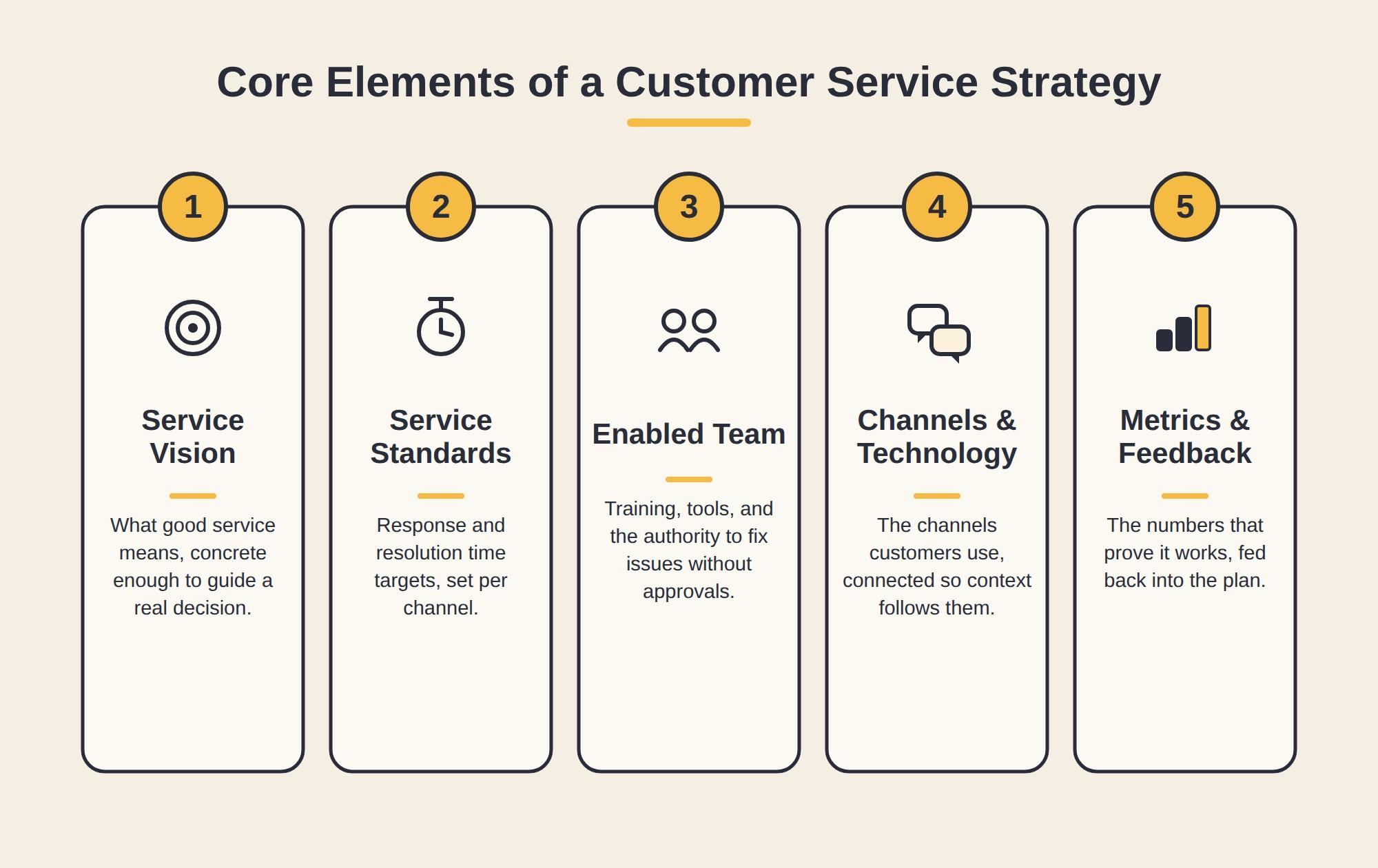
Before the steps, it helps to see the parts a strong strategy needs. Think of them as pillars that hold up everything else.
- A clear service vision. A line such as „No customer explains the same problem twice" gives an agent something to act on, where „delight every customer" does not.
- Defined service standards. Target response and resolution times per channel, plus a shared idea of what a quality answer looks like.
- An enabled team. Training, the right tools, and the authority to resolve issues without a chain of approvals.
- The right channels and technology. The channels your customers use, connected so context follows them, supported by automation where it earns its place.
- Metrics and a feedback loop. The numbers that tell you whether the strategy works, and a habit of feeding what you learn back into it.
These pillars depend on each other. A sharp vision falls apart when agents lack the authority to act on it, and good tools go to waste when no one measures the outcome.
How To Build a Customer Service Strategy Step by Step
Here is a practical sequence. Each step builds on the one before it.
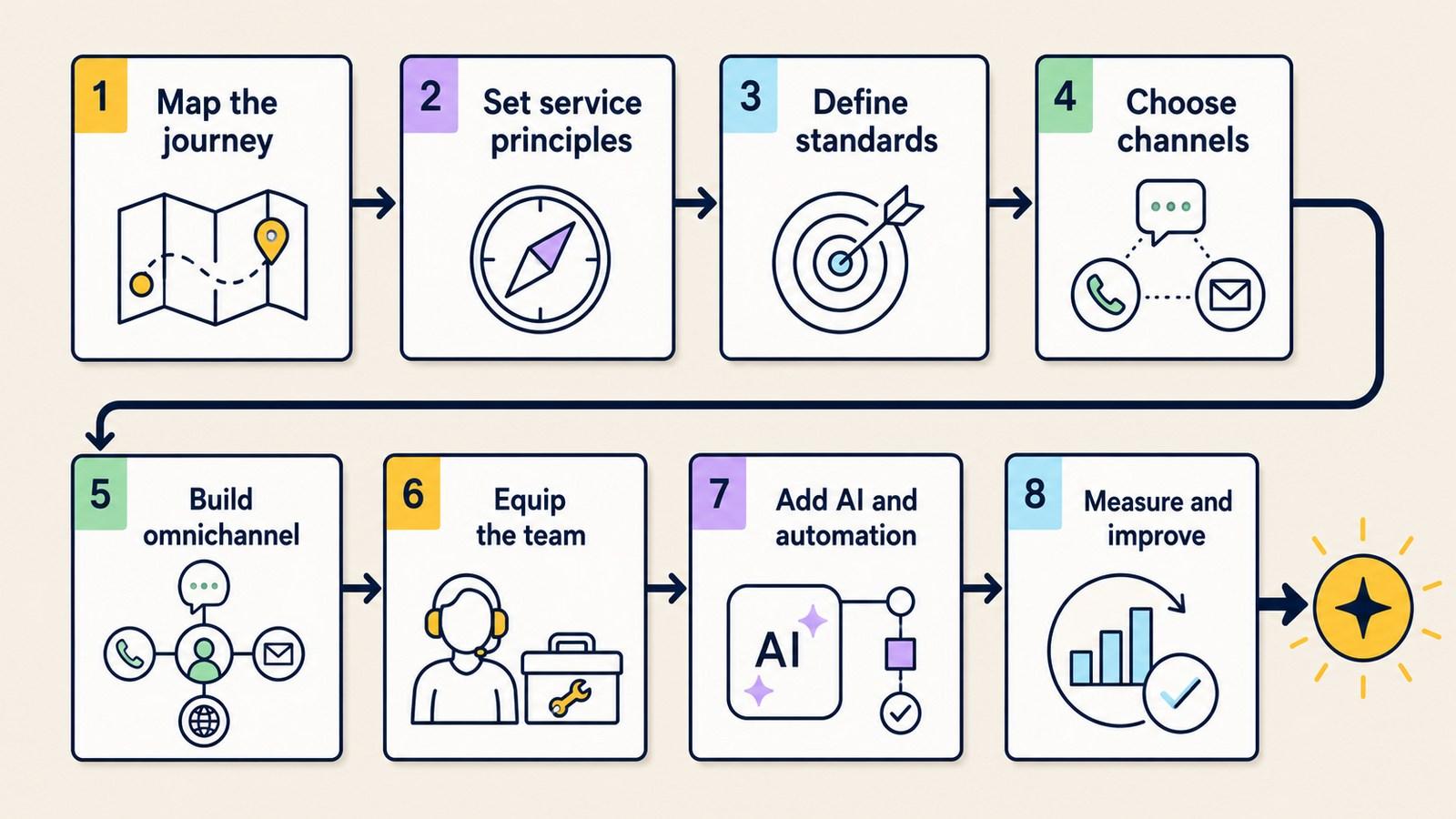
1. Understand Your Customers and Map the Journey
Start with the evidence you already have. Support tickets, chat logs, and channel data show you where customers get stuck and where they repeat themselves.
Map the journey from first contact to resolution, and mark the moments that determine satisfaction, such as the first reply and the handoff between agents.
One practical move is to pull your top 20 ticket reasons from last quarter. That short list usually points straight at the fixes with the highest payoff.
2. Define Your Vision and Service Principles
Turn your service vision into a handful of principles the team can apply under pressure. Keep them testable.
"Answer in the customer's channel of choice" is something an agent can act on and you can measure. Principles like these settle the small judgment calls that add up to a reputation.
3. Set Clear Service Standards and Goals
Attach numbers to the vision. Pick target response and resolution times for each channel, a first-contact resolution target, and a satisfaction goal, then tie each one to a business outcome like retention or fewer repeat contacts. Standards give agents a clear bar and give you a way to spot drift early.
4. Choose Your Channels Deliberately
Adding channels only helps when you can support each one well. Every channel you open needs an owner, set hours, response standards, and a way to measure it. Pick based on what your customers prefer and what each channel does best.
Voice and video suit complex or sensitive issues, live chat fits quick questions during a purchase, SMS works for short updates and confirmations, and messaging apps such as WhatsApp,Viber, and Facebook Messenger meet customers where they already talk. Email stays the workhorse for detailed, trackable requests. Add a channel once you can staff it and hold a consistent standard on it.
5. Build an Omnichannel Foundation
Customers move between email, chat, phone, and messaging apps inside a single issue, and they expect the context to move with them.
An omnichannel setup connects those channels so an agent sees the full history in one place, which spares the customer from retelling the story. Routing matters here too.
A solid call control and queuing setup sends each contact to the right agent the first time. Done right, a customer can move from chat to phone without starting over.
6. Equip and Train Your Team
Give agents the tools and the room to decide. A shared knowledge base keeps answers consistent, and an assist feature that drafts or suggests replies speeds up the routine work.
On email specifically, an AI email assistant can handle first drafts and summaries so agents spend their attention on the replies that need a human. Training is ongoing, and how you treat your team tends to show up in how they treat customers.
7. Add Automation and AI Where It Helps
Automation earns its place when it removes repetitive work and speeds up answers. Route and tag tickets automatically, deflect common questions to self-service, and let AI-powered features surface the next best step for an agent mid-conversation.
The point is faster resolutions for customers and more time for agents to spend on the cases that call for judgment. Analyst research projects that autonomous AI agents will resolve 80% of common service issues by 2029, alongside a 30% cut in operating costs, so building this capability now prepares you for that shift.
8. Measure, Review, and Improve
Set a review cadence, monthly or quarterly, and treat the strategy as a working document. Watch the metrics, look for the story behind a change, and feed what you learn back into your standards and training. A strategy gets better in the reviews, where you cut what is failing and put more weight on what works.
Metrics That Show Your Customer Service Strategy Is Working
Numbers turn a strategy from intent into something you can manage. Track a core set and read them together, because one metric alone can mislead.
- First response time and first contact resolution, for speed and effectiveness.
- CSAT and NPS, for how customers feel.
- Customer effort score, for how hard it was to get help.
- Average handle time and ticket volume, for operational load.
- Retention and churn, for the business result.
Balance operational metrics, which measure what your team does, with experiential metrics, which measure how the customer feels. A falling handle time next to a falling satisfaction score is a warning that agents are rushing, so the two only make sense side by side. A reporting and analytics view that puts these in one dashboard makes the weekly review far easier.
How AI and Automation Strengthen a Customer Service Strategy
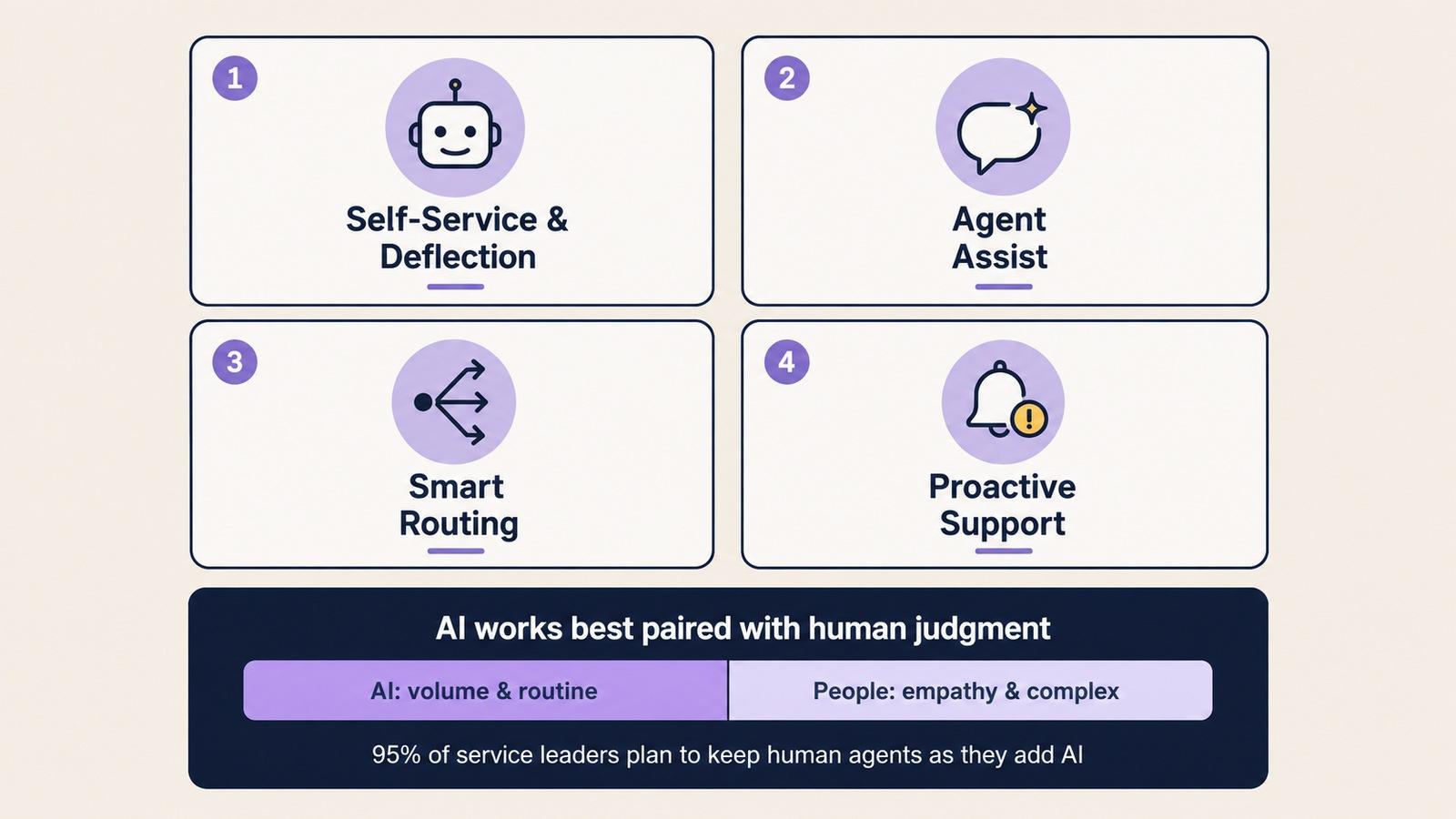
AI touches every part of the strategy, so it pays to plan where it goes. A few places return the most value.
Self-service and deflection. Let customers resolve simple issues on their own with an assistant that understands plain-language questions and completes real tasks. Done well, this frees your team for harder work.
Agent assist. Give agents real-time help, like suggested replies, surfaced knowledge, and automatic note-taking. This is the lowest-risk, highest-adoption use of AI, since it supports the person handling the case and speeds up their work.
Smart routing. Send each contact to the agent or bot best suited to it, so fewer issues bounce between people.
Proactive support. Use patterns in your data to reach out before a customer has to, like flagging a delivery problem early and offering a fix.
A word on balance. AI works best paired with human judgment. In one recent survey, 95% of service leaders said they plan to keep human agents as they add AI, describing a digital-first, human-supported model. In practice, AI handles volume and routine while people stay on the moments that need empathy and complex decisions.
Nexios brings these pieces together in one AI-powered platform, so the automation and the human handoffs live in the same workflow.
Common Customer Service Strategy Mistakes To Avoid
A few patterns undo otherwise good plans.
- A strategy nobody uses. A plan that lives in a slide deck changes nothing. Put the standards where agents work.
- Chasing vanity metrics. Cutting handle time at the expense of satisfaction trades a good number for an unhappy customer.
- Adding channels without connecting them. A new channel that starts every conversation from scratch adds effort for the customer.
- Automating a broken process. Fix the workflow first, then automate it, so you speed up something that already works.
- Skipping the feedback loop. A strategy that never revisits its results stops improving.
Customer Service Strategy FAQs
1. What is a customer service strategy? A customer service strategy is a company's plan for handling every customer interaction, setting the standards, channels, tools, and metrics that keep service consistent. It turns good intentions into a repeatable system.
2. What are the main elements of a customer service strategy? The main elements of a customer service strategy are a clear service vision, defined service standards, an enabled team, connected channels and technology, and a metrics-driven feedback loop. Each one supports the others.
3. How do you measure whether a customer service strategy is working? You measure a customer service strategy with a mix of operational and experiential metrics, such as first response time, first contact resolution, CSAT, NPS, and retention. Reading them together gives the clearest picture.
4. What is the difference between customer service and customer experience? Customer service is the help a company provides around specific issues, while customer experience is the sum of every interaction a customer has with the brand. Service is one important part of the wider experience.
5. How does AI fit into a customer service strategy? AI fits into a customer service strategy in self-service, agent assist, routing, and proactive outreach, handling routine volume so agents focus on complex cases. It works best alongside human judgment.
6. How often should you update your customer service strategy? Review a customer service strategy on a regular cadence, monthly or quarterly, and revise it whenever your metrics, channels, or customer expectations shift. Treat it as a living document.