How To Improve Customer Experience: 11 Steps and a 90-Day Plan
Customer experience is the sum of every interaction someone has with your business, from the first ad they see to the third time they call about the same problem. It runs through marketing, the website, buying, delivery, and support, so a company can employ helpful, well-trained agents and still leave customers frustrated when the steps between those agents are disconnected. That gap is wider than most companies realize.
In a 2025 global customer experience study, about nine in ten executives said customer loyalty had grown in recent years, while only four in ten consumers agreed, and nearly a third of consumers said they had stopped using a brand because of poor customer experience.
To improve customer experience, you have to find where customers hit friction, make communication easier, resolve issues on the first try, and keep the journey consistent across every channel. This guide walks through eleven steps that do exactly that, then a 90-day plan to put them in order, the metrics worth watching, and the mistakes that quietly undo the work.
What Is Customer Experience?
Customer experience is the impression that builds up in a customer's mind across every contact with your business, before, during, and after a purchase. It is not one department or one moment. It is the running total of how easy, clear, and respectful each step felt.
That impression forms across a wide set of touchpoints:
- Advertising and brand messaging
- The website and mobile app
- Sales conversations
- Account creation and onboarding
- Buying and payment
- Delivery or service fulfillment
- Customer support
- Returns, complaints, and cancellations
- Follow-up and retention
Many of the touchpoints that shape how customers feel never show up on an org chart. An IVR menu with no clear path to a person, a form that asks for an account number the agent then asks for again, hold music that gives no sense of the wait. These rarely appear in a formal journey map, and they set the tone before a customer ever reaches an agent.
Customer Experience vs Customer Service
Customer service and customer experience get used interchangeably, but they are not the same thing. Customer service is what happens when a customer needs help. Customer experience is everything around it. Customer service is one part of customer experience, which is why you can run an excellent support team and still lose customers to a checkout that fails or a returns process nobody can navigate.
| Customer service | Customer experience |
| Helps customers with questions or problems | Covers the complete journey |
| Usually reactive | Proactive and reactive |
| Owned by a support team | Shared across marketing, sales, product, operations, and support |
| Measured by response and resolution metrics | Measured by satisfaction, loyalty, effort, retention, and business outcomes |
How Do You Improve Customer Experience?
You improve customer experience by finding where customers hit friction and removing it, step by step.
That means mapping the full journey, acting on feedback, cutting effort, resolving issues faster and on the first contact, connecting your channels, personalizing with real context, empowering agents to solve problems, and measuring the result with metrics such as CSAT, CES, and first-contact resolution.
Each is an action you can take on its own, and the table below pairs it with the customer problem it solves and the metric that shows it is working.
| Action | Customer problem it solves | Useful KPI |
| Map the customer journey | Confusing, disconnected experiences | Journey drop-off rate |
| Collect and act on feedback | Unknown pain points | CSAT, NPS, CES |
| Reduce customer effort | Too many steps or transfers | Customer Effort Score |
| Improve response and resolution times | Long waits | First response time, resolution time |
| Raise first-contact resolution | Repeated contacts | First-contact resolution |
| Connect your channels | Customers repeat themselves | Transfer and repeat-contact rate |
| Personalize interactions | Generic communication | CSAT, retention |
| Empower agents | Slow or incomplete resolutions | Resolution time, escalation rate |
| Handle the routine with self-service and AI | High-volume repetitive requests | Self-service and automated resolution rate |
| Communicate proactively | Preventable contacts | Inbound contact volume |
| Test and improve continuously | Stagnant CX | CSAT and CES trend over time |
11 Ways To Improve Customer Experience
The actions below move from understanding the customer, to acting on what you learn, to measuring whether it worked. You do not need all eleven at once. Start where your customers feel the most friction, and use the metric next to each one to check that the change landed.
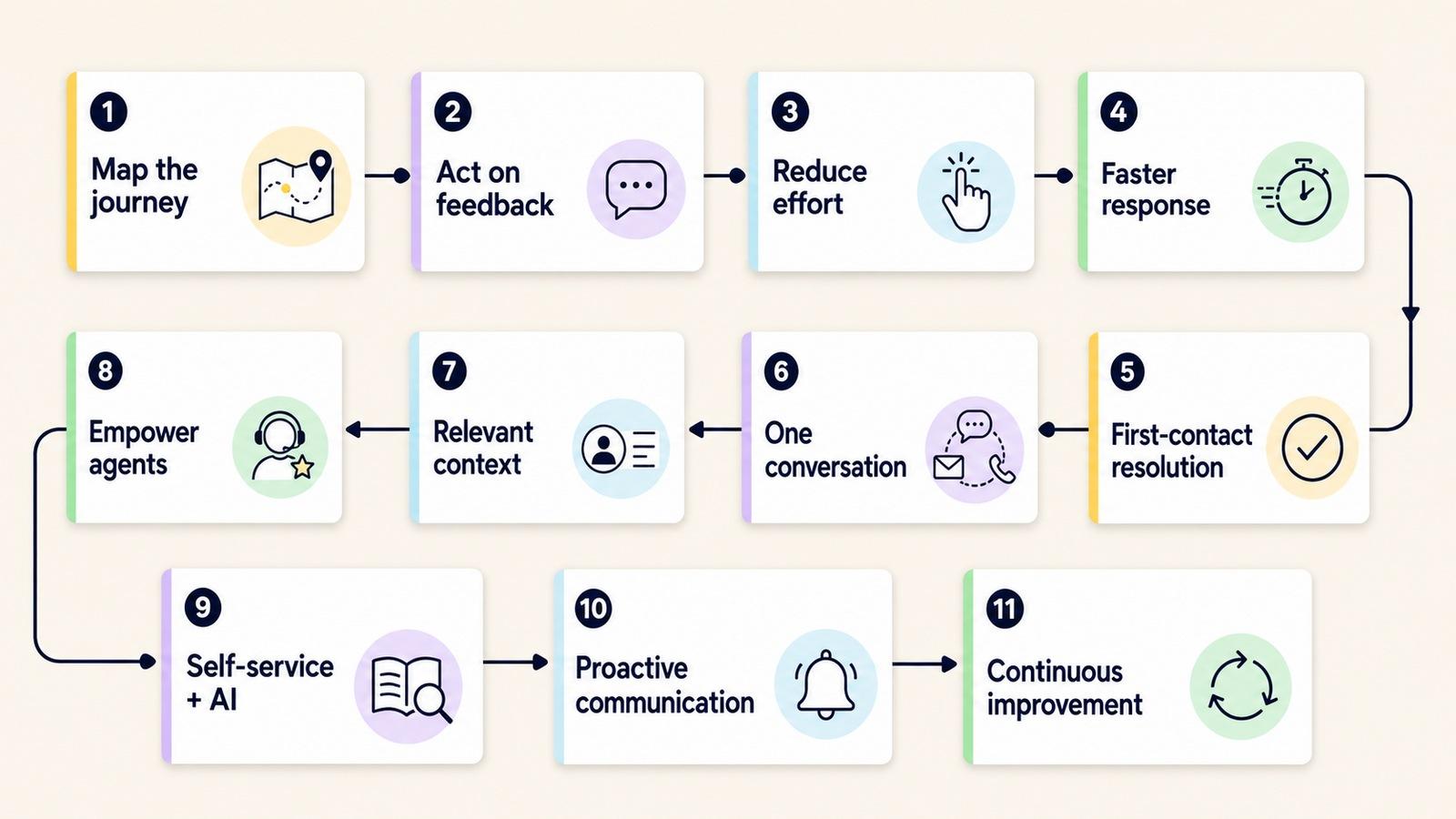
1. Map The Complete Customer Journey Using Real Data
A customer journey map lays out every stage of the relationship, from the first time someone hears about you through to renewal and advocacy. A useful map covers the full arc:
- Awareness and consideration
- Purchase or sign-up
- Onboarding
- Everyday use of the product or service
- Support
- Renewal or repeat purchase
- Advocacy
For each stage, note what the customer is trying to do, the questions they have, the channel they use, where they get stuck, and which team owns that moment. The column most teams leave blank is the customer's emotional state, and it is the one that predicts churn. A person anxious about a missed payment needs a different response than one casually checking an order.
Most journey maps describe the route the company designed. The useful version describes the route customers actually take, and you only see that in the data: where they drop off, where they double back, where they call a second time about the same thing. Map the journey customers live, not the one you drew on a whiteboard.
The quiet problems tend to hide in that gap between the designed journey and the real one.
Say your data shows a cluster of second calls about two days after sign-up. Each team looks at its own part and sees nothing wrong, because the broken step sits in the seam between onboarding and support, owned by neither. The map is what makes that seam visible.
You pull the raw material for this from your reporting and analytics: contact volume by reason, repeat-contact rate, and where conversations start and stop.
Useful metrics for this stage: journey completion rate, abandonment rate, and repeat-contact rate.
2. Collect Customer Feedback And Act On It
Collecting feedback is the easy half. The value comes from what you do next: grouping it, spotting the patterns, deciding what to fix first, and telling customers what changed.
Feedback arrives in two forms, and teams tend to over-weight the first.
Asked-for feedback comes from CSAT, NPS, and CES surveys, post-call ratings, and reviews.
Unasked-for feedback sits in support tickets, chat transcripts, call recordings, cancellation reasons, and the observations your frontline agents already carry.
Surveys mostly capture the delighted and the furious. The quieter majority shows up in behavior, in a repeated question or an account that closes without a word, and the unasked-for sources are often where the honest feedback sits.
Two habits decide if feedback changes anything.
The first is restraint. A survey after every interaction, five questions long, with no visible result, trains customers to ignore you and adds effort to the experience you are trying to improve. Ask less often, keep it short, and only ask when you will act on the answer.
The second is closing the loop. When feedback leads to a change, say so to the customer who raised it and to everyone affected by the same issue. "You told us the returns form was confusing, so we cut it from nine fields to four" does more for customer experience than the fix alone, because it shows customers that speaking up is worth the effort.
Your agents are a feedback channel in their own right. They hear the same complaints every day and usually know which step causes them. Listening to agents is a low-cost way to raise service quality, and it costs nothing but the discipline to ask and write down what they say.
Useful metrics for this strategy: survey response rate, CSAT, NPS, CES, and complaint volume.
3. Reduce Customer Effort At Every Touchpoint
Customers remember effort. Nobody thanks you for a form that was easy to fill out, but a process that made them log in twice, repeat their account number, and wait through a transfer stays with them and gets passed on to others. Every step you remove is one less chance to lose them.
Effort builds up across a touchpoint, so look for it in the small things: forms that ask for information you already hold, authentication steps that repeat, instructions that assume knowledge the customer does not have. Cut what you can, let customers stay in the channel they started in, and end every interaction with a clear next step so nobody is left wondering what happens now.
The highest-effort moment is usually the transfer, because the customer starts over. When a call reaches the right person the first time, the customer explains the problem once, and the clock on their patience never resets.
That is what changed for Margon Media. Using Nexios, they moved to skills-based routing that sends each call straight to the operator equipped to handle it. Agents stopped losing time passing customers around, and the company credits the change with a better experience for the people calling in. Fewer transfers are one of the most direct ways to lower customer effort.
Useful metrics for this strategy: Customer Effort Score, number of transfers, repeat contacts, and time to resolution.
4. Improve Response And Resolution Times
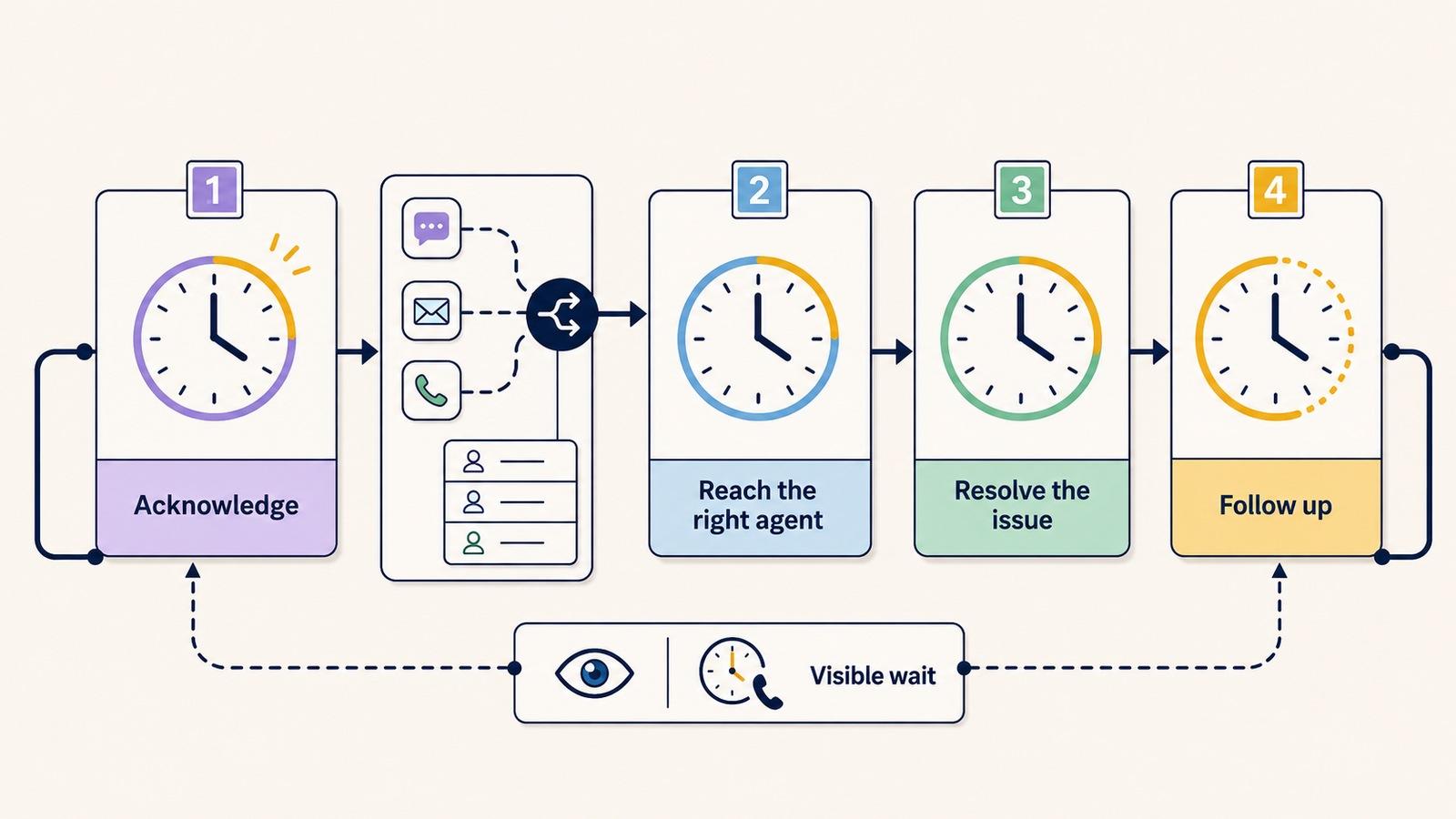
Speed matters, but "fast" hides four different clocks: how quickly you acknowledge the customer, how long it takes to reach someone who can help, how long the fix takes, and how long until the final follow-up. A business can win the first clock and lose the rest. An instant "we have received your message" reply looks responsive and resolves nothing.
The lever that moves the clocks that count is getting customers to the right place quickly: routing calls and messages to the agent equipped to handle them, managing the queue so waits stay predictable, setting clear escalation paths, and watching service levels so problems surface before customers complain.
Waiting also feels shorter when it is honest. A visible place in the queue, an estimated wait, or the option of a callback lowers the felt cost of waiting without changing its length. Customers forgive a wait they can see the end of.
Decathlon shows what queue management does at scale. Handling webshop support with Nexios, they held their monthly response rate above 90%, which means the large majority of customers who reached out got through. For a retailer, that is the difference between a resolved order and an abandoned basket.
Useful metrics for this strategy: first response time, average speed of answer, resolution time, and abandonment rate.
5. Raise First-Contact Resolution (Without Gaming It)
Solving a problem in the first interaction usually creates a better experience than a quick answer that only half-solves it. First-contact resolution, or FCR, measures how often that happens. It is one of the strongest signals in customer service, and one of the easiest to fake.
The faking comes from how you define "resolved." If FCR means the agent closed the ticket, agents will close tickets. If it means the customer did not come back about the same problem within the next few days, you are measuring the thing that matters. Define first-contact resolution by the absence of a repeat contact, not by a closed case.
With the right agent and full context already in place, the resolution work itself is straightforward: confirm the customer understood the answer, offer a real alternative when you cannot give them what they first asked for, and record the details so a second contact never starts cold.
VIK Split, a public water and sewerage utility, shows why this matters beyond the metric. Service had fallen so far that citizens had stopped calling, having lost faith that it would help. After moving to Nexios, with call recording, segmentation, and analytics giving the team a clear view of each case, resolution improved to the point that people started reaching out again, and the call center now resolves around 90% of inquiries. Reliable resolution rebuilds trust, but slowly.
Useful metric for this strategy: first-contact resolution.
6. Connect Every Channel Into One Conversation
Most companies offer several channels. Fewer connect them. That difference is the line between multichannel, where voice, email, chat, and messaging apps each run in their own lane, and omnichannel, where they share what the customer has already said.
The number of channels is not the point. A business can add SMS, WhatsApp, Viber, and Facebook Messenger and end up worse off, because each disconnected channel is one more place for context to vanish. The real test of omnichannel is simple: can the person who answers the phone see the chat from an hour ago?
When the answer is yes, the customer stops repeating themselves. Someone opens a question on live chat, gets a follow-up by email, and later calls to sort out the last detail. The agent who picks up that call can see the whole thread and carries on from where it stopped. No re-explaining, no starting over, no sense that the left hand has never met the right.
That is what customers mean when they say a company is easy to deal with: the channel changes but the conversation carries on.
Useful metrics for this strategy: channel transfer rate, repeat-contact rate, CSAT, and resolution time.
7. Personalize With Relevant Context
Personalization works when it saves the customer effort, and grates when it only shows off what you know about them. The test for any detail is whether it helps the person reach their goal. Greeting someone by name is courtesy. Pulling up their open order so they do not have to recite the number is useful. Reminding them you have tracked every page they visited is neither.
The context worth using is the context that shortens the conversation: past interactions, account type, purchase history, open tickets, preferred language, and where the customer is in their journey. A delivery update tied to an active order, a returning caller sent to the team that helped last time, a reply in the language the customer chose, each of these removes a step the customer would otherwise have to take.
Two rules keep personalization on the right side of the line. Use only what the interaction needs, and respect consent about what you hold. And keep the data clean, because wrong data makes personalization backfire. A renewal offer sent to someone who cancelled last week, or a greeting with the wrong name, tells the customer their history is not being read; it is being guessed at.
Useful metrics for this strategy: CSAT, retention, repeat purchases, and repeat-contact rate.
8. Give Agents The Context And Authority To Solve Problems
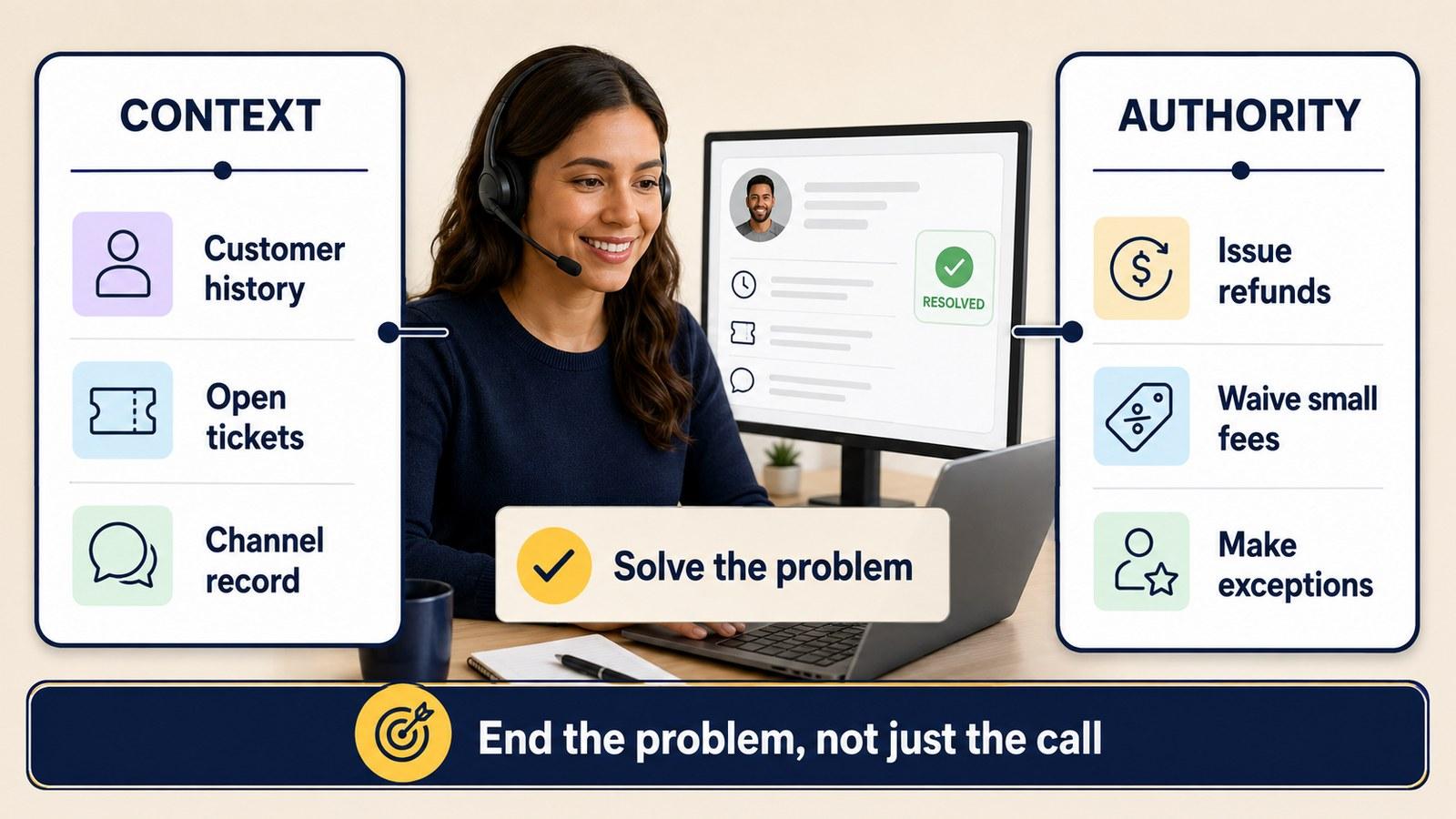
Employees shape customer experience more than any tool does, and the gap shows most in the hard moments: the complaint, the exception, the customer who is already annoyed. Two things decide how those go. One is the full picture. The other is the authority to act on it.
Context first. An agent hunting across five tabs for the account, the order, and the last conversation cannot sound calm and in control, because they are not. Put the customer's history, open tickets, and channel record on one screen, and the interaction changes tone at once. The agent stops apologizing for the wait and starts solving the problem.
Then authority. The most frustrating call in customer service is the one where the agent clearly understands the problem and cannot fix it. "I agree with you, but I am not able to do that" ends more relationships than a slow response ever will. Give agents room to resolve within sensible limits, to issue the refund, waive the small fee, or make the exception, and you remove the layer of frustration that turns a bad moment into a lost customer.
This works when the rest is in place: reliable internal information, training that keeps pace, clear escalation for the cases that need it, and quality reviews that coach instead of police. Measuring agents by call length alone undercuts all of it, because it rewards ending the call, not ending the problem.
Freeing agents for this kind of work is where automation earns its place. When routine, repetitive contacts are handled by self-service and AI, agents keep the time and attention for the interactions that need a human. A1 Slovenia did exactly this with Nexios: virtual queuing and moving simpler queries to chat lifted team productivity by 27%, while the customer experience they delivered held steady, which freed agents to spend more time on the hard cases.
Useful metrics for this strategy: agent productivity, employee satisfaction, FCR, CSAT, and escalation rate.
9. Handle The Routine With Self-Service And AI (Without Trapping People)
Most contact centers handle the same simple requests over and over, such as where is my order, reset my password, change my appointment, or what is my balance. Self-service and AI exist to take that volume off the queue, so customers get an instant answer and agents keep their attention for the problems that need a person.
Plain self-service covers a lot on its own: FAQs, order tracking, scheduling, password resets, account-status checks, and automated confirmations. AI extends the range, handling routine questions, drafting replies, summarizing a conversation for the next agent, reading sentiment, and answering in the customer's language.
The heading carries the warning. Automation should remove effort, not trap people in a loop with no way out. The fastest way to make customers hate a bot is to build one that cannot help and will not let them leave. Keep the route to a human obvious, and take it automatically when the issue is complex, the customer is frustrated, the request is an exception, the matter is sensitive, or the system is unsure.
This is the difference between deflection and resolution. Deflection counts a contact as a win the moment it is kept out of the queue, even if the customer left unsatisfied. Resolution counts it only when the problem is gone. Measure your automation by conversations resolved, not by contacts avoided, and it will improve the experience instead of hiding the problem. Keep it accurate, keep it inside the tasks it is good at, watch it for errors, and wire it to a human at every edge.
Useful metrics for this strategy: self-service and automated resolution rate, escalation rate, and CSAT on automated contacts.
10. Communicate Proactively
The best support interaction is the one that never had to happen. Proactive communication reaches the customer before a problem sends them to you, such as a delivery running late, an appointment tomorrow, a payment that failed, an outage the team is already working on, or a renewal coming up.
Told in time, each of these turns a would-be complaint into a moment of goodwill. A customer who hears their order is delayed before they go looking feels informed. One who finds out by chasing it feels ignored.
There is a line to hold. Proactive communication earns its place when it is timely, useful, and tied to something the customer needs to know. The moment it turns into a stream of promotions, it trains people to ignore the channel, and the outage alert that matters gets muted along with the coupons.
Keep the useful messages and the marketing messages apart, or you lose the useful ones. For a retailer, that means order confirmations, delivery updates, and reminders land as useful service.
Useful metrics for this strategy: inbound contact volume, complaint volume, missed appointments, and cancellation rate.
11. Test And Improve Continuously
Customer experience has no finish line, because the standard keeps moving. What impressed customers two years ago is the baseline now, so a program that ships once and stops slowly falls behind without anything visibly breaking.
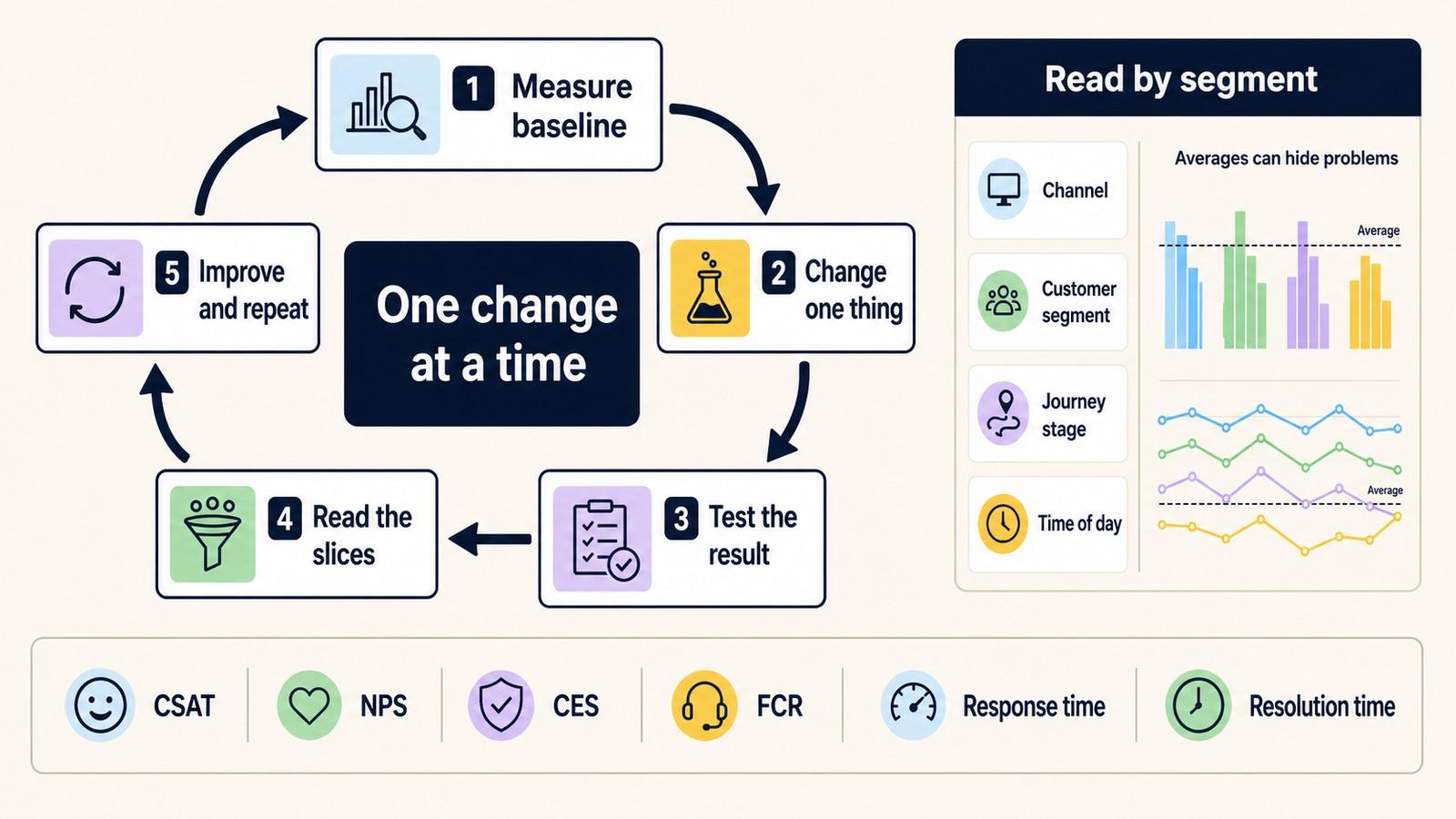
The way to keep pace is a steady loop of small changes, run often. Pick one pain point, measure where it stands today, make a single focused change, and see what the numbers do. Gather what customers and agents say about it, adjust, and move to the next one. Change one thing at a time, so you know what worked. A batch of ten simultaneous changes with no baseline leaves you certain something helped and unable to say what.
Read the results in slices, not in totals alone. The same CSAT figure can hide a channel that is failing, a segment that is slipping, or a time of day when everything backs up. Break the numbers down by channel, customer segment, product, location, agent group, journey stage, issue type, and time of day, and the real story shows up in the gaps between the averages.
Useful metrics for this strategy: CSAT, NPS, CES, FCR, response and resolution time, churn, and repeat contacts.
How To Measure Customer Experience Improvement
You cannot improve what you only feel, and no single number captures customer experience on its own. The strategies above each name the metric that fits them, so the job here is not another list. It is knowing how to read those metrics together.
Three kinds of signals answer three different questions.
- Customer sentiment, from CSAT, NPS, CES, and review sentiment, tells you how the experience felt.
- Operational data, from first-contact resolution, response and resolution time, abandonment, and repeat-contact rate, tells you what happened.
- Business outcomes, from retention, churn, lifetime value, and renewals, tell you whether any of it reached the bottom line.
Read one column alone, and you miss the picture. A number that looks strong in one can hide a failure in the next. The clearest example is average handling time.
Falling handle time reads like progress, faster calls and more of them. Then you notice repeat-contact rate climbing beside it, and the story flips: agents are closing conversations, not solving them, and the same customers keep calling back. Always read handle time against resolution, since any metric taken in isolation can point the wrong way.
Sentiment scores have the opposite blind spot. They tell you something went wrong without telling you where. A CSAT that drops for two weeks is a signal, not a diagnosis, so pair it with the operational numbers to find the step that broke.
And give every figure something to compare against, your own trend over time and an industry benchmark where you have one. A satisfaction score means little without something to compare it against. Your reporting and analytics are where these numbers sit close enough together to read side by side.
A Practical 90-Day Customer Experience Improvement Plan
Eleven actions are easy to read and hard to sequence. The mistake most teams make is starting with the fix instead of the diagnosis, changing things that were never the problem.
This plan puts the work in order: understand first, fix the few that matter most, then measure and widen what worked. Ninety days is enough to show real movement on one or two problems, and to build the habit that keeps it going.
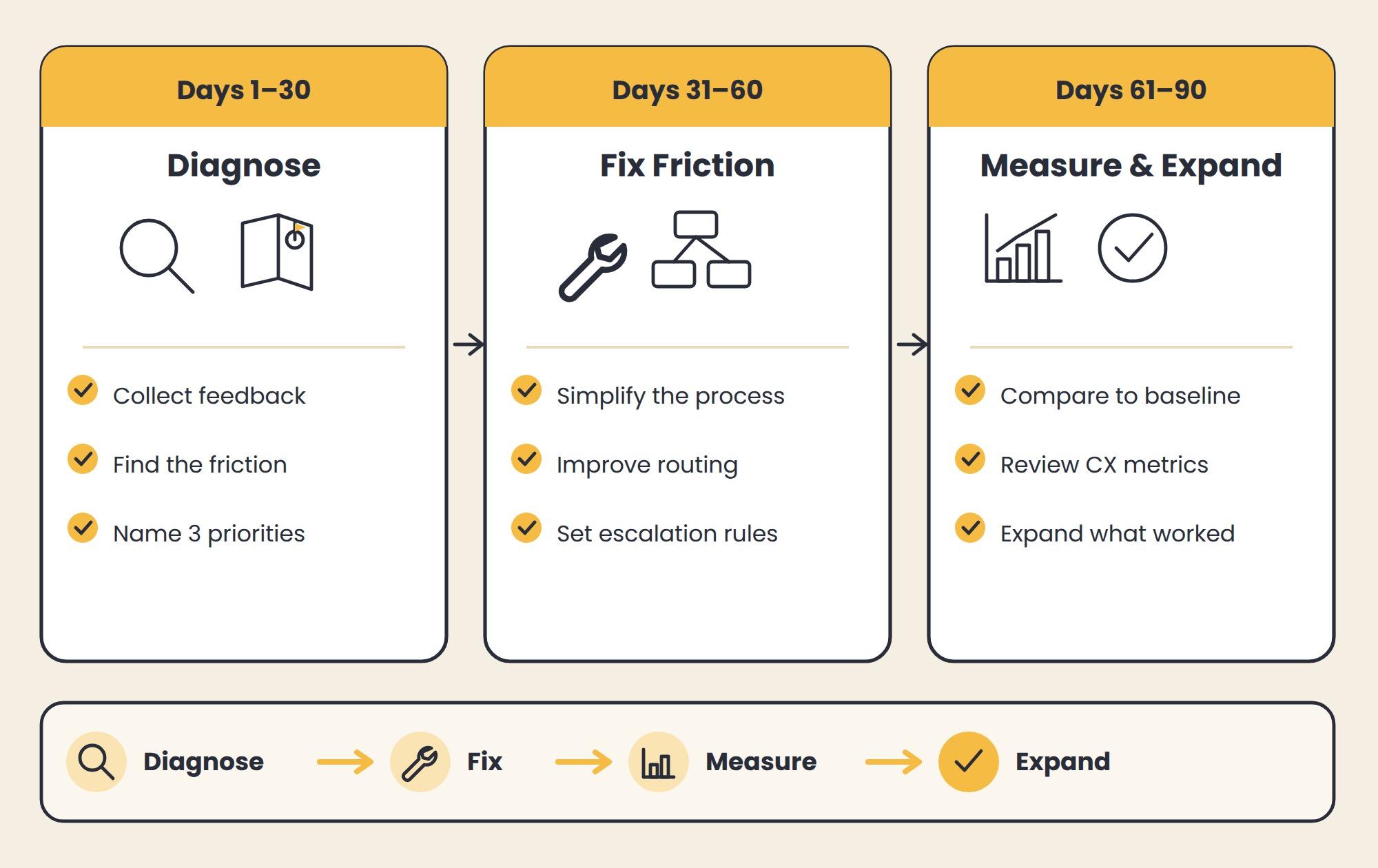
Days 1–30: Diagnose The Current Experience
Spend the first month learning where the experience breaks, before touching anything. Resist the urge to fix as you go.
- Pull feedback from every source you have: surveys, reviews, tickets, chat logs, call recordings, and cancellation reasons.
- Review why people contact you, and rank the reasons by volume.
- Measure current response and resolution times, and abandonment.
- Find the most common repeat contacts, the issues that generate a second call.
- Map the primary customer journey and mark where people drop off.
- Sit with agents and ask them where the friction is. They already know.
- Name the three biggest friction points. Only three.
Days 31–60: Fix High-Impact Friction
Now act on the three problems you named, and nothing else. Fix a few things well instead of many things badly.
- Simplify the one process that causes the most effort.
- Improve routing or queue management so customers reach the right person faster.
- Correct the customer-facing information that is out of date or unclear.
- Build or repair one self-service flow for a high-volume request.
- Set clear escalation rules, so the path to a human is defined.
- Connect the channels involved, so context follows the customer.
- Train agents on what changed, and why.
Days 61–90: Measure And Expand
The last month tells you whether the work landed and turns a one-time push into a routine.
- Compare the numbers against the baseline you set in month one.
- Review CSAT, CES, FCR, and response and resolution times side by side.
- Ask customers and agents whether the change is felt on the ground.
- Look for side effects, a fix in one place that added friction in another.
- Expand what worked to the next segment, channel, or issue type.
- Set a recurring CX review, so improvement does not stop at day 90.
Common Customer Experience Mistakes To Avoid
The actions above are what good customer experience looks like. These are the habits that quietly undo it. Most are not failures of effort; they are reasonable decisions that made sense in isolation and cost you at the seams, where one team's fix becomes another's friction. Read the list as a checklist of what to steer clear of: if any feel familiar, they are worth fixing before they spread.
- Launching new channels that cannot see each other's history
- Running surveys that never lead to a visible change
- Rewarding fast closes over problems that stay solved
- Forcing the customer to re-establish who they are at every step
- Pushing complex or emotional issues onto a bot
- Burying the route to a human behind menus
- Leaving stale answers in the knowledge base
- Handling a frustrated customer and a routine one identically
- Collecting agent complaints and shelving them
- Flooding customers with proactive messages they did not need
- Optimizing the support desk while the rest of the journey stays broken
- Changing ten processes at once with no baseline to measure against
How Nexios Helps Improve Customer Experience
Almost everything in this guide depends on one condition: the channels, the customer's history, and the numbers all need to sit in one place. When they are scattered across separate tools, context falls through the gaps, and no single view tells you what to fix. Nexios is built to close those gaps: a browser-based contact center that brings the whole operation together.
That shows up as four practical outcomes.
- Customers reach you where they already are. Voice and video, email, SMS, live chat, WhatsApp, Viber, and Facebook Messenger run as one connected set, managed from a single platform, so a conversation that starts in one place continues in another without restarting.
- Agents get the context to resolve problems. History, open tickets, and the full thread arrive on one screen, and skills-based routing puts each contact in front of the person equipped to handle it.
- AI and automation carry the routine. AI handles repeat questions, drafts replies, reads sentiment, and answers across languages, which keeps agents free for the work that needs a human, with a clear path back to one when it does.
- Managers can see what to improve. Reporting and analytics with custom KPIs turn the day's activity into the side-by-side numbers the measurement section described.
None of this is theory. The examples throughout this guide, from a public utility that won back the citizens who had stopped calling to a retailer answering the large majority of its contacts, come from teams running this on Nexios.
If you want a faster, more connected customer experience, talk to the Nexios team and see how the channels, AI, routing, and analytics fit your own operation.
How To Improve Customer Experience FAQs
1. What is the best way to improve customer experience? The best way to improve customer experience is to start with the customer problems that cause the most effort, map the journey to find them, fix the highest-impact friction first, and measure the change with both customer feedback and operational data. There is no single fix; the gains come from removing friction step by step.
2. How can customer service improve customer experience? Customer service improves customer experience by responding quickly, resolving issues on the first contact, carrying context between conversations so customers do not repeat themselves, and keeping a clear path to a human when one is needed.
3. What are the most important customer experience metrics? The most important customer experience metrics combine three views: sentiment (CSAT, NPS, CES), operational performance (first-contact resolution, response and resolution time, repeat-contact rate), and business outcomes (retention and churn). No single metric tells the whole story, so read them together.
4. How can businesses improve customer experience with technology? Businesses improve customer experience with technology by connecting their channels, putting customer context in front of agents, automating routine requests, routing contacts to the right person, and turning daily activity into analytics that show what to fix.
5. How does personalization improve customer experience? Personalization improves customer experience when it uses relevant context, such as order history or preferred language, to save the customer effort. It works only when the data is accurate and limited to what the interaction needs.
6. How can AI improve customer experience? AI improves customer experience by handling routine questions instantly, drafting replies, reading sentiment, supporting multiple languages, and freeing agents for complex work. It should always hand off to a person when the issue is complex or sensitive.
7. What is the difference between customer experience and customer service? Customer service is one part of customer experience. It is the help a customer gets with a question or problem, while customer experience covers the whole relationship across marketing, sales, buying, support, and retention.
8. How often should a business review its customer experience? A business should monitor its core customer experience metrics continuously and run a structured review monthly or quarterly, depending on its size, contact volume, and how often it changes processes.
Get free insights via email
Practical support insights on service metrics, AI and the playbooks teams actually run, straight to your inbox. Free, unsubscribe anytime.