7 Strategies To Improve Customer Satisfaction
Improving customer satisfaction is both harder and more urgent than it used to be. The American Customer Satisfaction Index, a national benchmark, held at 76.9 out of 100 in the fourth quarter of 2025, down 0.5% year over year, and has not materially increased since 2017. Customer expectations keep rising while most companies hold steady, so the gap between what people expect and what they get keeps widening.
The good news is that satisfaction comes down to a few things you can control: how fast you respond, how consistent you are across channels, how personal each interaction feels, and whether you act on what customers tell you. That last one is where most teams fall short, measuring satisfaction, collecting the responses, then changing nothing the data points to.
A full customer communication platform can bring these moving parts into one place, but the tooling only supports the habits, it does not replace them. So the guide works in that order: measure first, then improve, then keep improving.
What Customer Satisfaction Really Means
Customer satisfaction is how well an experience matches what the customer expected. You can measure it at a single moment, such as right after a support call, or across the whole relationship with your brand. Both views matter, and they do not always agree.
That gap is why satisfaction and loyalty are not the same thing. A customer can be happy with one interaction and still leave, and a loyal customer can absorb a bad day without churning. Satisfaction captures a single moment, while loyalty reflects the pattern over time. This is the first reason you end up tracking more than one metric.
The business case is direct. Bad experiences are expensive, and customers act on them faster than most companies assume. A 2025 global study found that 34% of consumers reduce their spending with a company after a negative experience, and another 13% stop spending with it entirely. Scaled across the economy, that adds up to nearly $3 trillion in global sales at risk.
So satisfaction works as a retention lever. One poor experience is often enough to move a customer toward a competitor, so the real goal is to remove the specific failures that push people out the door.
How To Measure Customer Satisfaction Before You Improve It
You cannot fix what you have not measured. Before changing anything, get a baseline, then track it over time so you can tell whether your changes moved the number. Reporting and analytics matter here, because a satisfaction program depends on seeing the trend over time.
Three metrics cover most of what you need, and each answers a different question.
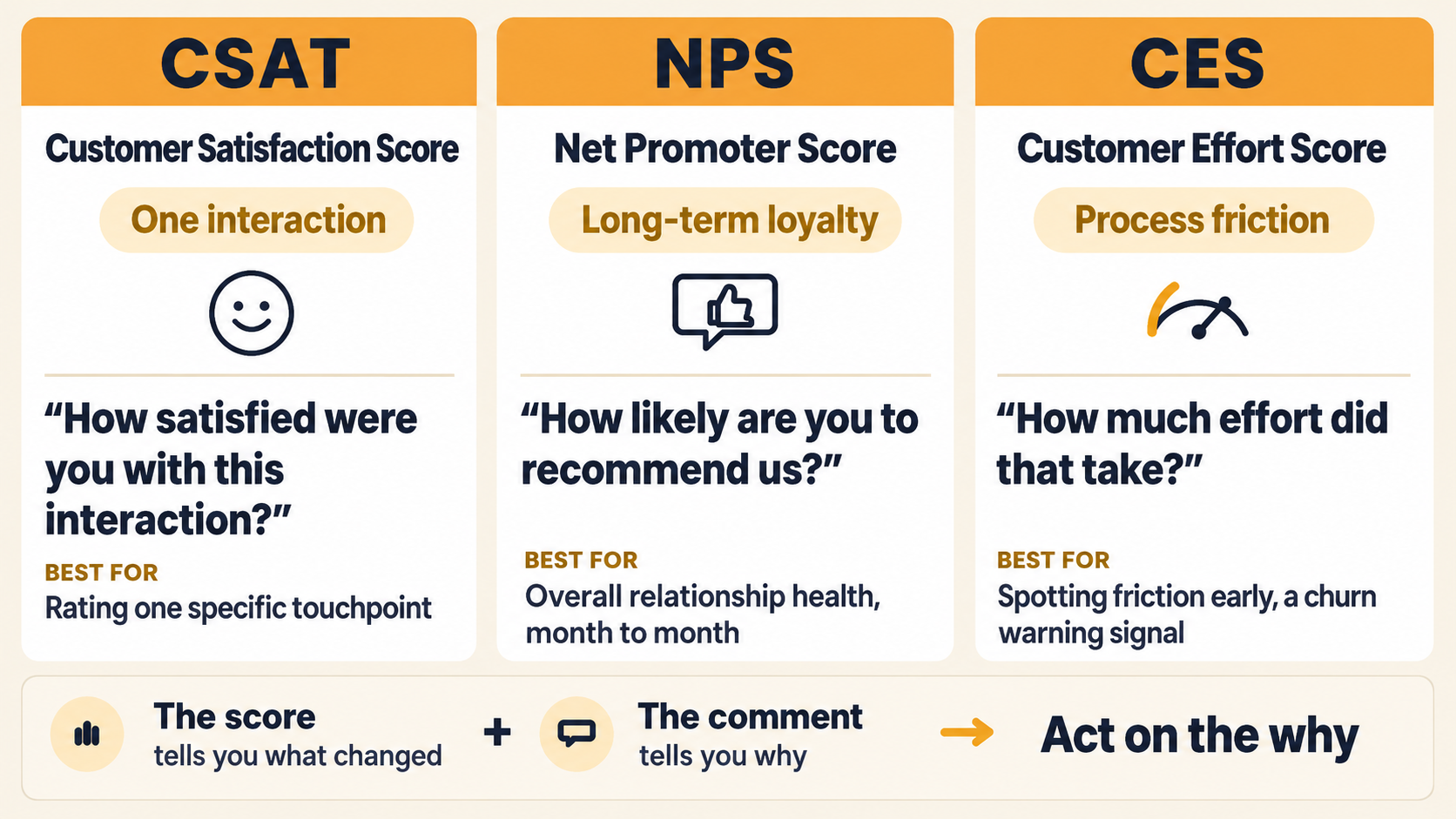
CSAT (Customer Satisfaction Score) measures satisfaction with a specific interaction. You ask a customer how satisfied they were right after a support call or a purchase. It is best for pinpointing how a single touchpoint performed.
NPS (Net Promoter Score) measures long-term loyalty by asking how likely someone is to recommend you. It is best for tracking the health of the overall relationship across months and quarters.
CES (Customer Effort Score) measures how hard the customer had to work to get their outcome. It is best for finding friction in a process, and it carries a useful edge. Effort is one of the strongest predictors of whether a customer stays or leaves, which makes CES a useful early warning signal.
Do not launch all three at once. Most teams start with NPS for the high-level view, then add CSAT and CES on the touchpoints that matter most, such as post-support or checkout.
One more thing separates a real program from a dashboard nobody uses. A score with no reason behind it cannot be acted on. Pair every survey with an open comment field, and route that feedback to the team that can fix the underlying issue. A score flags that something changed. The open comments explain the cause, and the cause is where you focus the fix.
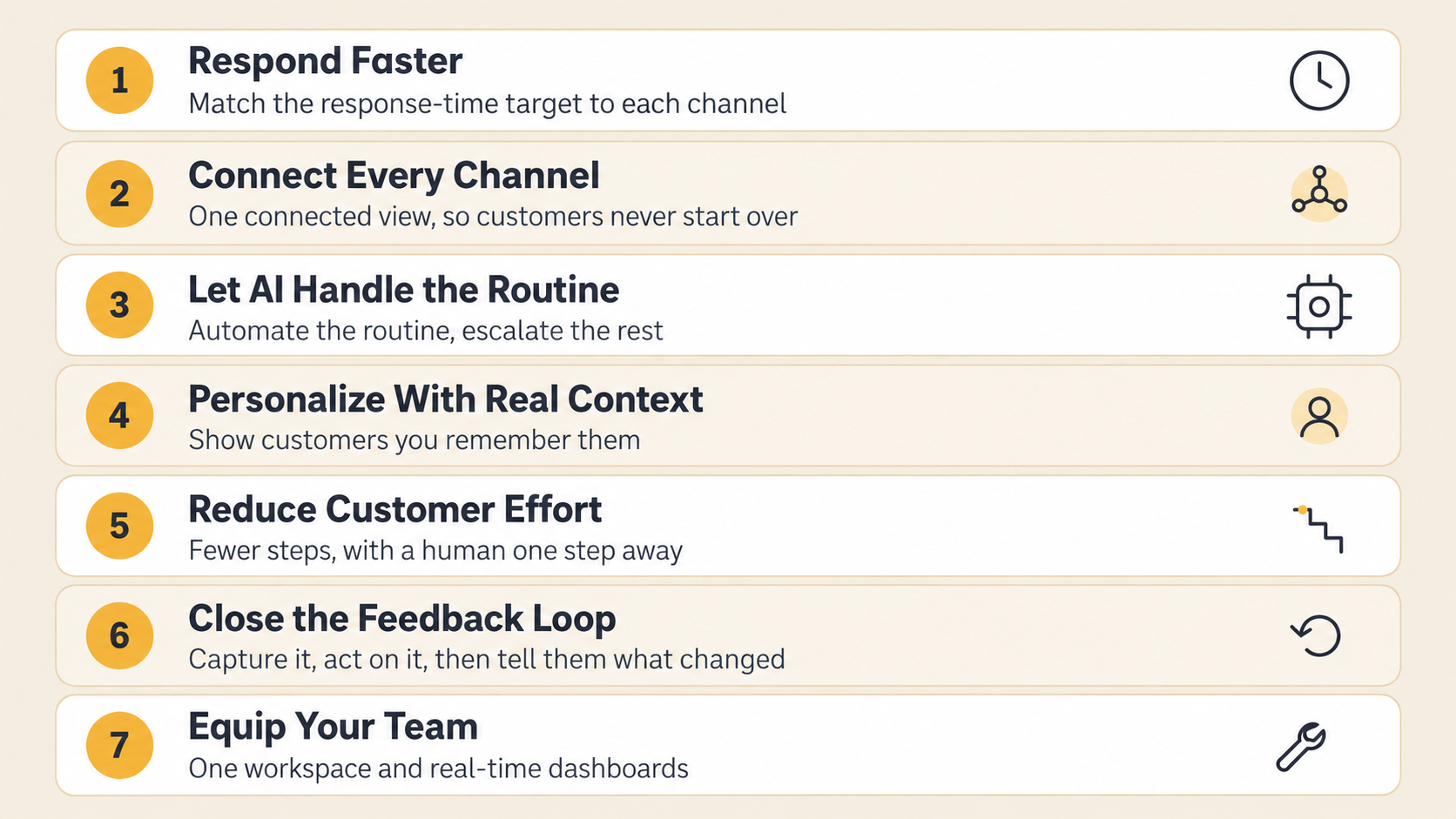
7 Ways To Improve Customer Satisfaction
With a baseline in place, you can improve the drivers that move it. These strategies target the ones that show up most across the research, from response speed to follow-through. You do not need all of them at once, so start where your own numbers are weakest.
1. Respond Faster And Set Clear Response-Time Standards
Speed is the most consistent driver of a good or bad interaction. When people recall a great support experience, they almost always mention how quickly it was handled, and slow first responses are one of the most common reasons a satisfied customer starts looking elsewhere.
"Be faster" is not a plan, though. Set a target first-response time for each channel, publish it internally, and staff against it. The targets should match the channel. A one-hour first reply on email is reasonable. On live chat, customers expect something close to instant, a reply in seconds.
The mechanics that move response time sit underneath the target. Route each query to the agent who can solve it, give supervisors visibility into the queue so backlogs get caught early, and offer a callback instead of making people wait on hold. Smart call routing and queuing turns a response-time target into a number you hit consistently.
A quick reply that bounces the customer to a second and third person is slower than one thorough answer that resolves the issue on first contact. Speed only helps when the answer also ends the problem. The goal is a fast answer that also ends the problem, not a fast acknowledgment that starts a relay.
2. Bring Every Channel Into One Place
Customers move between phone, email, chat, and messaging apps without thinking about it, and they expect you to keep up. The frustration shows up every time a customer switches channels and has to repeat their account number and their whole story from the top.
The difference between multichannel and omnichannel matters here. Multichannel means you are present on many channels. Omnichannel means those channels are connected behind a single view, so the context follows the customer. The second one is what improves satisfaction, because the customer never starts over.
That means covering the channels customers use. Voice and video, email, SMS, live chat, WhatsApp, Viber, and Facebook Messenger all belong in the mix. Covering the channels is the easy part. Connecting them so context follows the customer is where satisfaction improves.
Picture the common case. A customer starts a conversation on WhatsApp in the morning, then calls in the afternoon to finish it. In a connected setup, the agent who answers the call already sees the WhatsApp thread and picks up where it left off.
In a disconnected one, the customer explains everything again, and the goodwill from the first exchange is gone. That "start over" tax is one of the quietest and most avoidable sources of frustration.
3. Let AI Handle Routine Requests And Free Up Agents
The clearest satisfaction win from AI is capacity. It handles high-volume, repetitive questions instantly and around the clock, which shortens queues and lets human agents spend their time on the cases that need judgment. Used this way, AI-powered support raises satisfaction on both sides of the conversation, since customers wait less and agents stop drowning in the same five questions.
Industry research shows how widely companies are committing to this: around 80% of organizations expect to increase their AI investment.
That capacity only pays off when it is aimed at the routine, high-volume work. Good candidates are status checks, frequently asked questions, simple account actions, and routing to the right department.
Getting this wrong costs as much as getting it right. A bot that traps a customer in a loop with no way out lowers satisfaction fast. People react badly when a machine stands between them and a human they need.
Resolve the issue quickly, or hand off to a person with the full context already attached, and never leave the customer at a dead end. Customers accept AI when it is accurate and knows when to step aside, and resent it when it turns into a wall between them and a person.
4. Personalize Every Interaction With Real Context
Personalization here means using what you already know about someone, their history, past issues, and preferences, so the interaction shows you remember them. The expectation is now baseline. A 2024 global study found that 64% of consumers, nearly two in three, prefer to buy from companies that tailor the experience to their wants and needs.
In practice, this is concrete. Greet a returning customer with their account context already loaded. Reference the last interaction instead of asking them to recap it. Pre-fill details you already have so they do not re-supply them. Each of these removes a small friction, and the small frictions are what add up to a mediocre experience.
Personalization and data hygiene turn out to be the same project. An agent can only personalize if the customer's history is in front of them, and it usually is not, because it sits scattered across separate tools that do not talk to each other.
This is where management and integration do the quiet work, pulling records into one place so the person or the AI handling the conversation has the context to use.
5. Reduce Customer Effort And Make Help Easy To Reach
Effort is the quiet satisfaction killer. A customer can get the outcome they wanted and still walk away annoyed if it took four steps, two transfers, and a repeated explanation. CES is built to catch exactly this friction, and the stakes are high.
Customers who have to fight for a resolution, through transfers, repeated explanations, and dead ends, are far more likely to leave than those who get an easy answer.
Reducing effort takes a few habits. Offer a clear help center so customers can settle simple questions on their own. Keep the path to a human short for everything else. And stop forcing channel switches that make people start over. Done well, self-service respects the customer's time on the easy questions so your agents have room for the hard ones, and a human stays one step away.
If a good help center resolves the top five repeat questions your team gets, agents reclaim hours every week, and those hours go to the complex, high-value cases that need a person. The customer with a simple question gets an instant answer, and the customer with a complicated problem gets a focused agent. Both come out ahead.
6. Collect Feedback And Close The Loop
Closing the loop separates a real satisfaction program from survey theater. The loop has four steps. Capture feedback at the right moment, route it to an owner, act on it, and tell the customer what changed.
Most teams do the first step and stop, which trains customers to ignore the surveys. Fewer than one in three consumers now share feedback with companies at all, an all-time low, so the responses you do get are worth acting on.
The mechanism matters. Feedback that lands in an inbox disappears. Feedback that becomes a tracked task with an owner and a due date gets fixed. Running this through ticketing and task management keeps a complaint from evaporating before anyone addresses the root cause.
Closing the loop also means reaching back out. A quick follow-up after a resolved issue, or after a rough interaction, recovers satisfaction and often saves the relationship. This is where outbound campaigns come in, turning a one-time fix into a visible signal that you were paying attention.
Responding to an unhappy customer and fixing what went wrong is the single highest-impact move most teams skip, and it is often what turns a detractor back into a loyal customer. A survey you never act on trains customers to stop answering, while a closed loop shows them that speaking up leads to change.
7. Give Your Team The Tools to Do The Job Well
Slow, disconnected tools produce slow, frustrating service, and no amount of coaching fixes a workflow that makes agents dig through five tabs to answer one question.
Give agents one workspace instead of a stack of disconnected apps. Give supervisors real-time dashboards so a building backlog gets spotted before it turns into a wave of complaints. And make the team's key numbers visible, so everyone can see how they are doing.
Metrics like average handle time and first-contact resolution move before CSAT does. When handle time creeps up or first-contact resolution slips, satisfaction is usually about to follow, so these operational numbers give you a head start on a problem while you can still fix it quietly.
Common Mistakes That Lower Customer Satisfaction
Most satisfaction problems come from a handful of repeatable mistakes. Each one has a straightforward fix.
- Measuring but never acting. Running surveys and changing nothing they reveal is the most common failure of all. The fix is the closed loop, routing every finding to an owner who can act on it.
- Treating each channel as a silo. When channels do not share context, customers repeat themselves and satisfaction drops. Connect them so history follows the customer.
- Optimizing for speed at the expense of resolution. A fast reply that does not solve the problem creates a second contact. Measure first-contact resolution alongside response time.
- Automating without an escape hatch. AI that blocks access to a human backfires. Keep escalation one clear step away.
- Asking for feedback too often. Survey fatigue burns the goodwill you need. Ask less, at the right moments, and show that responses lead to change.
How Nexios Helps You Improve Customer Satisfaction
Most of what improves satisfaction is habit, but the right platform makes those habits the default instead of a constant effort. That is the idea behind Nexios.
The pieces line up with these strategies. Connected omnichannel keeps the customer's context intact as they move between channels. Routing and queuing shorten first responses. AI absorbs the routine volume and covers off-hours, while agents handle the cases that need a human. Ticketing turns feedback into tracked follow-through. And analytics let you measure CSAT, NPS, and CES in one place, then act on what they show.
Teams across retail and e-commerce, finance, and other sectors run their customer care on a setup like this, because the underlying service demands are similar.
To see how it maps to your own service operation, you can book a demo and walk through it with the team.
How To Improve Customer Satisfaction FAQs
1. What is the fastest way to improve customer satisfaction? The fastest way to improve customer satisfaction is usually to cut response time and reduce customer effort, since slow replies and repeated explanations are the most common sources of frustration.
2. How do you measure customer satisfaction? Customer satisfaction is measured with short surveys, most often CSAT for a specific interaction, NPS for long-term loyalty, and CES for how much effort the customer had to spend.
3. What is a good customer satisfaction score? A good CSAT score depends heavily on your industry, so a benchmark that looks strong in one sector is average in another. Your own trend over time is a more reliable signal than any universal target.
4. Does omnichannel support improve customer satisfaction? Omnichannel support improves customer satisfaction because it carries the conversation across channels, so customers do not have to repeat their issue every time they switch from chat to phone or email.
5. Can AI improve customer satisfaction? AI improves customer satisfaction when it resolves routine questions instantly and hands complex cases to a human with full context, which shortens wait times without making the experience feel impersonal.
Get free insights via email
Practical support insights on service metrics, AI and the playbooks teams actually run, straight to your inbox. Free, unsubscribe anytime.