How to Respond to a Frustrated Customer Email: 12 Samples to Copy
A frustrated customer email tends to arrive when your queue is already full, and the pressure to reply fast can make it harder to reply well. You want to calm the customer, fix the problem, and keep the relationship, while the person on the other end is often already expecting the worst.
Knowing how to respond to a frustrated customer email comes down to three moves. Acknowledge the frustration, apologize for the specific issue, and give a clear next step with a time attached to it.
Many frustrated emails fall into a handful of predictable situations, so below you’ll find one universal sample, 12 samples by situation, the phrases worth replacing, and a pre-send checklist.
A Universal Frustrated Customer Email Sample You Can Use Right Away
When the inbox is full and a customer is clearly upset, this sample works for most complaints and buys you time without sounding like a form letter.
Subject: Re: [Original subject] [Ticket #12345]
Hi [Customer name],
Thank you for writing to us, and I understand why you’re frustrated. [Describe the issue in one sentence, e.g., “Your order hasn’t arrived, and the tracking page hasn’t updated since Tuesday.”] I’m sorry this happened.
Here’s what I’ve done so far: [action, e.g., “I’ve contacted our delivery partner and asked for the package’s current location.”]
I’ll update you by [day and time], even if I’m still waiting on an answer. If anything changes on your side before then, reply to this email and it’ll come straight to me.
Best, [Your full name] [Team name] | [Direct phone or email]
Before sending, swap in the specific issue and a follow-up time you can actually keep.
7 Parts of a Reply That Calms a Frustrated Customer
A reply that calms an upset customer has seven parts, and each one answers a question the customer is silently asking, from “did anyone read this?” to “who do I talk to next?”
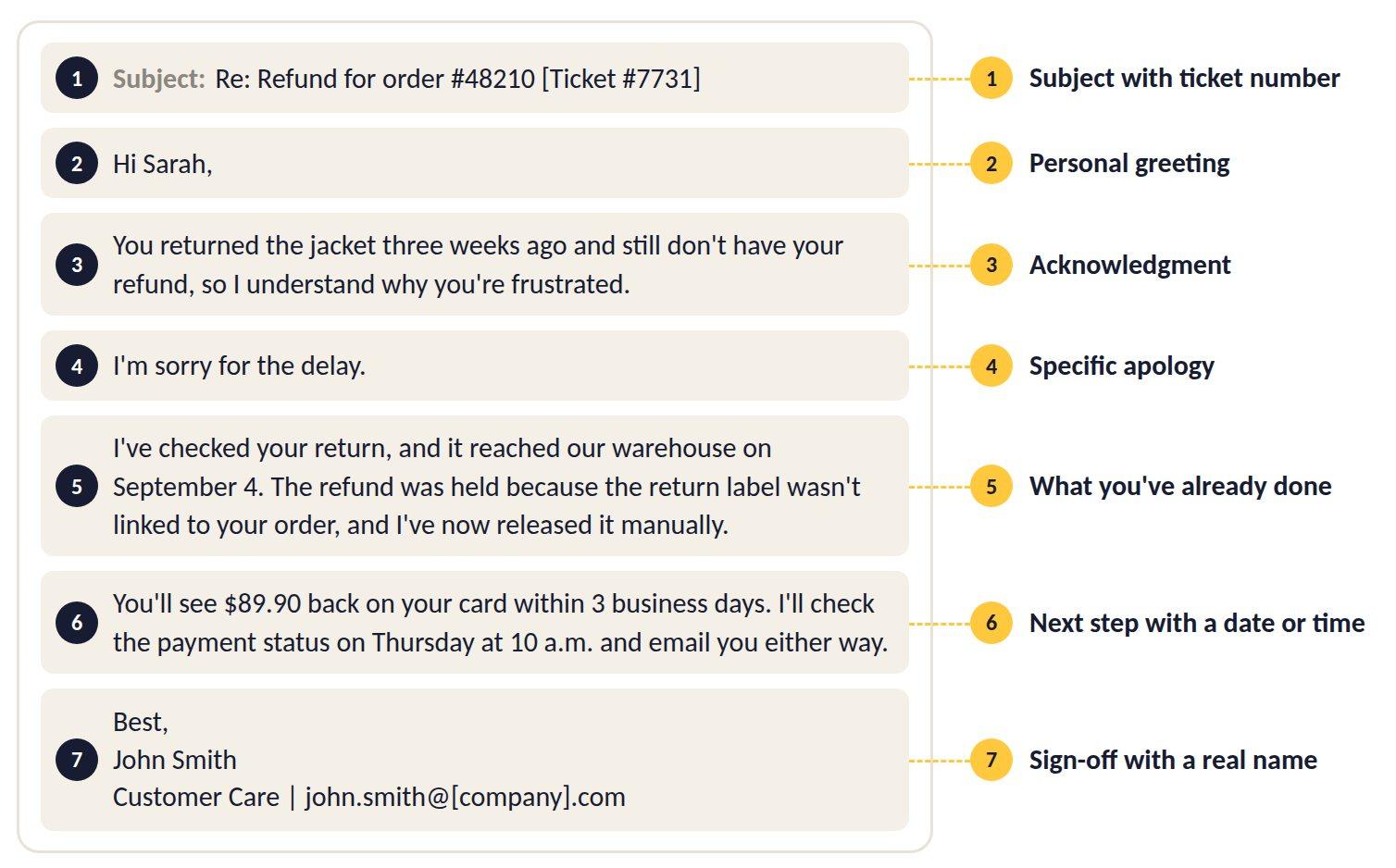
- A subject line that keeps the thread or ticket number, so the customer can find the conversation and your team can see its full history.
- A personal greeting with the customer's name, since "Dear customer" tells them they're just one more ticket in the queue.
- Acknowledgment of the frustration in your own words, for example, “Waiting two weeks for a replacement is a long time, especially after you paid for express shipping.”
- A specific apology that names the problem, which is far more convincing than a general “sorry for any inconvenience.”
- What you've already done, even a small step such as checking the warehouse log, so the customer can see the case is moving.
- The next step with a date or time, because "soon" and "shortly" mean different things to every reader.
- A sign-off with a real name and a direct way to reply, so the customer knows there’s a person behind the answer.
A Weak Reply vs. a Strong One
Take one common complaint, a delayed refund, and see how the same agent could answer it two ways. Sarah returned a jacket three weeks ago and still hasn’t seen her money.
Weak reply:
Dear customer,
We apologize for any inconvenience. Refunds can take some time to process. As stated in our policy, please allow up to 14 business days. We’ll look into it.
Customer Service Team
Strong reply:
Subject: Re: Refund for order #48210, Ticket #7731
Hi Sarah,
You returned the jacket three weeks ago and still don’t have your refund, so I understand why you’re frustrated. I’m sorry for the delay.
I’ve checked your return, and it reached our warehouse on September 4. The refund was held because the return label wasn’t linked to your order, and I’ve now released it manually.
You’ll see $89.90 back on your card within 3 business days. I’ll check the payment status on Thursday at 10 a.m. and email you either way.
Best, John Smith Customer Care | john.smith@[company].com
What changed between the two:
Three things changed between the two replies. The strong one opens with a specific apology that names the refund and how long Sarah waited, lists the action already taken, and swaps "we'll look into it" for a firm follow-up time signed with John's own name.
12 Frustrated Customer Email Samples for Common Situations
Here’s a quick map of what each situation needs, so you can find the right sample before reading it in full.
| Situation | What the reply must include | What to offer |
| 1. You need time to investigate | Confirmation you’ve read it, a time for the full answer | A firm update time |
| 2. Late or missing delivery | Current order status, what you’ve asked the carrier | Tracking update, reshipment, or refund |
| 3. Wrong, damaged, or incomplete order | Apology for the specific item, how to return it | Free replacement or refund, prepaid label |
| 4. Didn’t meet expectations | What the customer expected vs. what they got | Help using it, exchange, or refund |
| 5. Outage or technical issue | What’s affected, current status | Status updates, service credit where it applies |
| 6. Billing error or unexpected charge | The charge explained, masked account details | Correction or refund with a date |
| 7. Customer waited too long | Apology for the wait, the actual answer | Priority handling |
| 8. Same problem again | Ownership of the repeat, one named contact | A committed resolution date |
| 9. Complaint about an agent | Thanks for reporting, what happens next | A review and a new contact |
| 10. Refund or policy exception | A clear yes or no with the reason | The refund, or the closest alternative |
| 11. Handing to a specialist | Who’s taking over, why | Full handover so the customer doesn’t repeat themselves |
| 12. Follow-up after the fix | Confirmation the issue is closed | A direct line back if it returns |
1. First Reply When You Need Time to Investigate
When to use: The customer is upset, and you can’t give a full answer until another team checks the details.
Subject: Re: [Original subject] [Ticket #12345]
Hi [Customer name],
Thanks for letting us know about [issue]. I can see why this is frustrating, and I’m sorry you’ve had to deal with it.
I’ve passed your case to our [team name] team, who can check [specific detail]. I’ll email you with a full answer by [day and time]. If I don’t have it by then, I’ll still write to tell you where things stand.
Best, [Your name]
Why it works: The customer gets a real time instead of silence, which removes the urge to send a second, angrier email.
2. Late or Missing Delivery
When to use: The order is past its delivery date or the tracking hasn’t moved for days.
Subject: Re: Where is my order? [Order #12345]
Hi [Customer name],
Your order was due on [date], and I’m sorry it still hasn’t arrived. I checked the tracking, and the package was last scanned in [location] on [date].
I’ve opened an inquiry with [carrier] and asked them to locate it. If there’s no update by [day], I’ll send a replacement at no cost, or refund you in full if you’d prefer. Just let me know which works better.
Best, [Your name]
Why it works: Checking the tracking yourself shows real effort, and the customer gets a choice with a deadline attached.
3. Wrong, Damaged, or Incomplete Order
When to use: The customer received the wrong item, a broken one, or only part of the order.
Subject: Re: Damaged item in order #12345
Hi [Customer name],
Thank you for sending the photo, and I’m sorry the [product] arrived [damaged / missing / in the wrong size], which isn’t what you paid for.
I’ve arranged a replacement, which ships today and should reach you by [date]. You don’t need to send the original back. [Or: A prepaid return label is attached, and you can drop the package at any [carrier] point.]
Best, [Your name]
Why it works: The fix is already done when the customer reads the email, so there’s nothing left to argue about.
4. Product or Service Didn’t Meet Expectations
When to use: Nothing is technically broken, but the customer feels the product isn’t what they were promised.
Subject: Re: [Product] isn’t what I expected
Hi [Customer name],
Thanks for the honest feedback. You expected [what they expected], and I understand the disappointment when [product] didn’t deliver that.
Two options are open to you. I can set up a 15-minute call to show you [feature that may solve it], or I can arrange a full refund within our [30-day] return window. Reply with the one you’d like, and I’ll sort it the same day.
Best, [Your name]
Why it works: It takes the expectation seriously without admitting a defect that isn’t there, and offers a way forward in both directions.
5. Service Outage or Technical Issue
When to use: A telecom network, software-as-a-service (SaaS) app, or online service is down or not working as it should.
Subject: Re: Internet down since this morning [Ticket #12345]
Hi [Customer name],
I’m sorry your connection has been down since [time]. I know that means [real impact, e.g., “you can’t work from home today”].
Our engineers have confirmed an outage affecting [area / feature] and are working on it now. The current estimate for a fix is [time]. I’ll email you as soon as service is back, and send an update by [time] at the latest either way.
Once it’s resolved, I’ll check whether a service credit applies to your account.
Best, [Your name]
Why it works: It names the real impact on the customer’s day, which a generic “we’re experiencing issues” never does.
6. Billing Error or Unexpected Charge
When to use: The customer was charged twice, charged the wrong amount, or doesn’t recognize a charge. Never paste the full account or card number into the reply.
Subject: Re: Double charge on my account [Ticket #12345]
Hi [Customer name],
Thank you for flagging this. I can see two charges of [amount] on [date] to the card ending in [last 4 digits], and I’m sorry for the worry that caused.
The second charge was a duplicate, and I’ve issued a refund today. Depending on your bank, it’ll appear within [number] business days. I’ll check on [date] that it’s gone through and confirm with you.
Best, [Your name]
Why it works: Plain words and only the last four digits keep the reply easy to follow and keep sensitive data out of the inbox.
7. Customer Waited Too Long for a Reply
When to use: The customer’s email sat unanswered for days, and the wait itself is now part of the complaint.
Subject: Re: Still waiting for an answer [Ticket #12345]
Hi [Customer name],
You wrote to us on [date] and still haven’t heard back, and I’m sorry you’ve had to wait this long.
Here’s the answer to your question: [answer]. I’ve also marked your case as a priority, so if you need anything else on this, reply here and I’ll get back to you by [time] the same day.
Best, [Your name]
Why it works: The apology is short, and the answer comes right after, which respects the time the customer has already lost.
8. Customer Is Writing About the Same Problem Again
When to use: The customer has already contacted you about this issue, and the first fix didn’t hold.
Subject: Re: Third time writing about this [Ticket #12345]
Hi [Customer name],
This is the [second / third] time you’ve had to contact us about [issue], and that’s on us. I’m sorry the earlier fix didn’t solve it.
From now on, I’m your single contact for this case, so you won’t need to explain it again. I’ve [action taken] and asked [team] to find what caused the problem in the first place. You’ll have a full resolution by [date], and I’ll update you every [day / two days] until then.
You can reach me directly at [email / phone].
Best, [Your name]
Why it works: Owning the repeat and naming one contact removes the customer’s biggest fear, which is starting over with someone new.
9. Complaint About an Agent
When to use: The customer is unhappy with how a team member treated them.
Subject: Re: Complaint about my call on [date]
Hi [Customer name],
Thank you for telling us about your experience on [date]. You should have been treated with patience and respect, and I’m sorry that didn’t happen.
I’m reviewing the conversation with the team lead this week. I’ll also take over your original request myself, and here’s where it stands: [status]. I’ll update you by [day and time].
Best, [Your name] [Role, e.g., Customer Care Team Lead]
Why it works: Staying neutral about the colleague keeps the focus on the customer, and the original issue still gets solved.
10. Refund or Policy Exception: Saying Yes and Saying No
When to use: The customer asks for a refund or an exception, and you need to either approve it or explain why you can’t.
Saying yes:
Subject: Re: Refund request for order #12345
Hi [Customer name],
I’ve approved your refund of [amount]. Our usual window is [30 days], but given [reason], it’s the right call here.
You’ll see the money on your card ending in [last 4 digits] within [number] business days. I’ll confirm on [date] once it’s processed.
Best, [Your name]
Saying no:
Subject: Re: Refund request for order #12345
Hi [Customer name],
Thanks for your patience while I checked this. Your order was placed on [date], which is outside our [30-day] refund window, so I’m not able to issue a full refund.
Here’s what I can do within our policy: [alternative, e.g., “a store credit for the full amount, valid for 12 months” or “a free repair”]. If that works for you, reply and I’ll set it up today.
Best, [Your name]
Why it works: Both versions give the reason in one sentence, and the “no” always comes with something the customer can say yes to.
11. Handing the Case to a Specialist or Manager
When to use: The issue needs someone with more authority or technical knowledge than the first agent.
Subject: Re: [Original subject] [Ticket #12345]
Hi [Customer name],
To get this fixed properly, I’m handing your case to [name], our [role], who handles [type of issue]. I’ve shared everything you’ve told us, including [key details], so you won’t need to repeat it.
[Name] will contact you by [day and time]. I’m copied on the thread, so feel free to reply here if anything’s unclear.
Best, [Your name]
Why it works: The customer knows exactly who’s taking over and when, and that the case history travels with it.
12. Follow-Up After the Issue Is Fixed
When to use: A few days after the fix, to confirm everything is still working.
Subject: Checking in on [issue] [Ticket #12345]
Hi [Customer name],
Last week we [fix, e.g., “replaced your router”], and I wanted to check that everything’s working as it should.
If the problem has come back, reply to this email and it’ll come straight to me. Thanks again for your patience while we sorted it out.
Best, [Your name]
Why it works: A follow-up nobody asked for tells the customer the case mattered even after it was closed.
8 Phrases to Replace When You Reply to an Angry Customer
Some phrases feel polite to the person writing them and sound dismissive to the person reading. Here are eight common ones and what to write instead when you reply to an upset customer.
| Instead of: | Write: |
| Sorry you feel that way → | I understand why this is frustrating |
| As I said before → | To recap where things stand |
| That’s our policy → | Here’s what I can do within our policy |
| There’s nothing I can do → | Here’s what I can do right now |
| Calm down → | I want to get this fixed for you |
| You should have → | Next time, here’s the quickest way to |
| We’ll look into it → | I’ll update you by [day and time] |
| Unfortunately → | [Start with the solution instead] |
Each swap moves the focus from what went wrong to what happens next, which is the part the customer cares about.
How Fast Should You Reply to a Frustrated Customer?
Confirm you’ve received the email quickly, then give a firm time for the full fix. A two-line acknowledgment within the working day tells the customer someone is on it, and the full answer can follow once you have it.
Two terms help here. A service level agreement (SLA) is the response time your team commits to, either to customers or internally. First response time (FRT) is how long it takes from the moment an email arrives until a person replies to it.
Independent research firms haven't published a reliable benchmark for complaint email response times, so set your own SLA based on your team's capacity based on your team’s capacity, write it down, and track FRT for complaint emails separately from general questions, since a frustrated customer who’s left waiting often writes again.
Tools with reporting and analytics let you build custom reports and see those numbers on a real-time dashboard.
What to Do When the Customer Rejects Your Solution
Sometimes Emily, a long-time customer, reads your carefully written offer and replies with “That’s not good enough.” When that happens, work through these steps:
- Ask what outcome she expects. A direct question such as “What would a fair resolution look like for you?” often shows the gap is smaller than it seemed.
- Offer one realistic alternative, and resist listing five, since a long menu reads as a negotiation.
- If the email thread keeps going in circles, suggest a short call and propose two time slots.
- When the case is beyond your authority, escalate with the full context so Emily doesn’t have to tell the story again.
When a Customer Crosses the Line
If the messages turn into threats, stop replying on your own and pass the thread to your team lead. Keep the full history in the ticket so whoever takes over has the context and can follow your company's security policy.
Frustration is normal, but your team doesn’t have to accept insults or threats. Set a boundary politely and keep the door open for the actual issue.
Subject: Re: [Original subject] [Ticket #12345]
Hi [Customer name],
I want to help resolve [issue], and I’m still working on it. I’m not able to continue the conversation if messages include personal insults toward our team.
If you reply about [issue], I’ll pick it up right away, and you’ll have an update from me by [day and time].
Best, [Your name]
How to Keep Customer Data Safe in Complaint Emails
A frustrated customer often sends everything at once, from their card number to a photo of their ID, hoping it’ll speed things up. Handle that data carefully, since everything in the thread stays in your inbox and your support system.
- Verify the customer’s identity with a security question, a code sent to their registered phone number, or a login to their account before you discuss any account details.
- Mask card and account numbers, showing the last 4 digits only.
- Never ask for passwords or full ID numbers by email, and if a customer sends them anyway, delete the data from the thread and let them know you’ve done it.
In the EU, the General Data Protection Regulation (GDPR) covers every piece of personal data in a complaint email.
If a reply with personal data goes to the wrong person, that can count as a personal data breach, which GDPR requires you to report to your national data protection authority within 72 hours, unless it’s unlikely to put anyone at risk.
Teams in banking and other regulated industries usually need GDPR-compliant contact center software that lets them define data-retention periods, user roles, and permissions according to their internal policies and regulatory requirements.
Turn Repeat Complaints Into Fixes
A catch-all “Other” tag often hides three or four separate problems, and nobody notices until the same complaint has come in fifty times.
Tag every complaint email by category as soon as it arrives, for example “late delivery,” “billing,” or “login issue.”
Once a month, review the top categories and fix the root cause.
Keep the category list short enough that agents can pick one in a few seconds, and give each category an owner who reports what changed since the last review. When a fix goes live, email the customers who complained about it, so they can see their complaint led somewhere.
If late deliveries keep coming from one carrier or one region, that’s a conversation for operations, and a ticketing system for tasks across the organization lets support send the case to the team that can fix it.
6 Checks Before You Hit Send
Run through these six checks before any reply to an angry customer leaves your outbox.
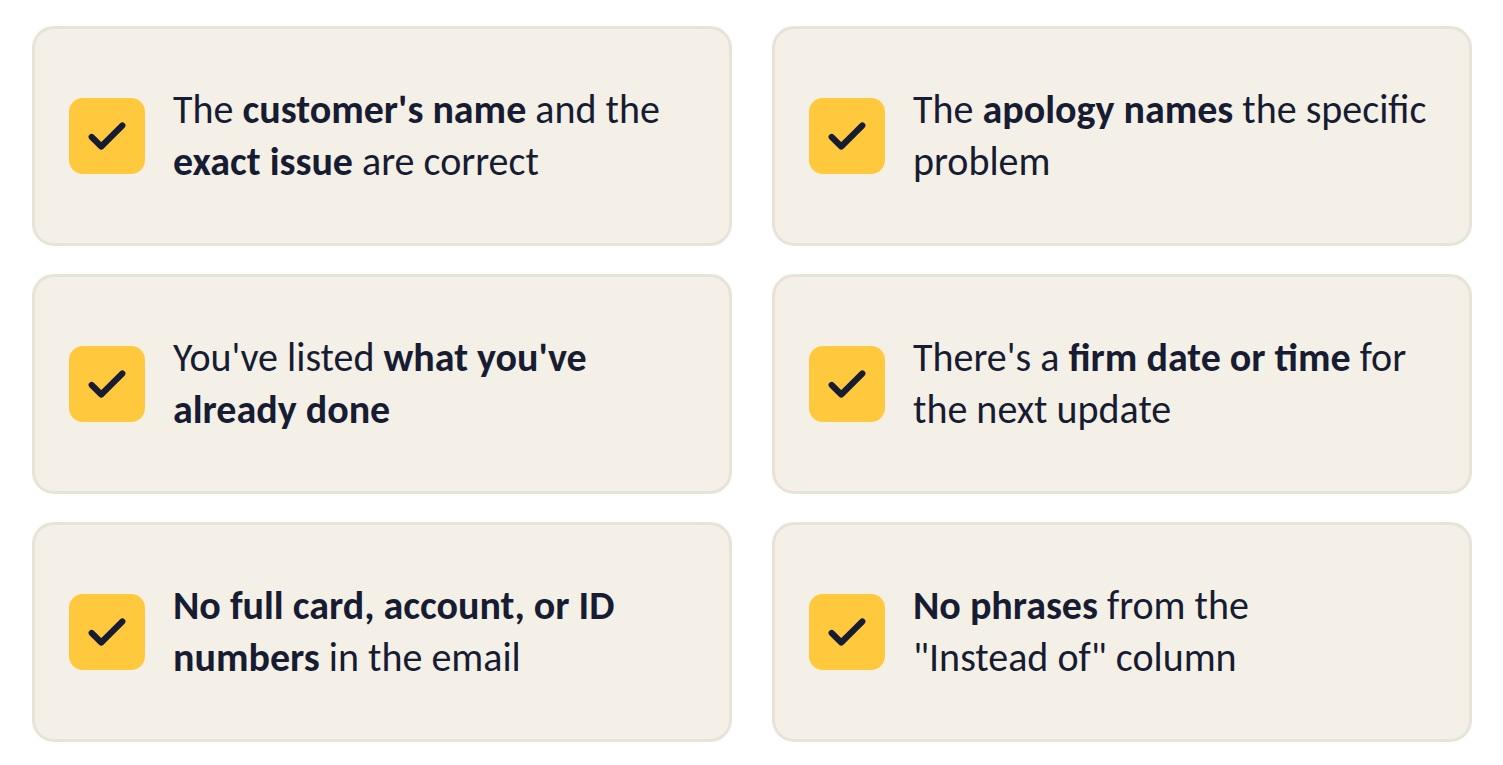
- The customer’s name and the exact issue are correct.
- The apology names the specific problem.
- You’ve listed what you’ve already done.
- There’s a firm date or time for the next update.
- No full card, account, or ID numbers appear in the email.
- None of the phrases from the “Instead of” column made it into the reply.
How Nexios Helps Your Team Answer Frustrated Customers
When complaints pile up, emails slip through the cracks long before anyone writes a bad reply. The Nexios platform brings voice, video, email, SMS, live chat, WhatsApp, Viber, and Messenger into one unified interface, so an agent can see the whole conversation history before answering.
For email, Nexios supports:
- Plain text or HTML email templates so agents can save the 12 samples above once and reuse them.
- Mail categorization, so every complaint gets a category and a clear owner.
- Email as a task, where each complaint becomes a trackable item that can’t get lost in a shared inbox.
See how your team could handle every complaint from one inbox. Get started with Email
How to Respond to a Frustrated Customer Email FAQs
1. How do you start an email to a frustrated customer?
Start an email to a frustrated customer with their name, a short thank-you, and a sentence that shows you understand the problem, for example "Thank you for writing to us. Your order was due on Monday, and I'm sorry it still hasn't arrived."
Keep the thank-you to one line and name the issue right after it, so the customer sees straight away that you've read their email.
2. Should you apologize if it wasn’t your company’s fault?
Yes, you should apologize for the customer’s experience, even when the cause sits with a carrier, a bank, or the customer’s own mistake.
“I’m sorry your package is stuck in customs” shows empathy without admitting fault, and then you can explain what caused the delay and what you’re doing about it.
3. Is it okay to use templates for complaint emails?
Templates are fine for complaint emails as long as you personalize the key details before sending. Always change these three things:
- The customer’s name
- The specific issue and what you’ve done about it
- The date or time for the next update
A template that still says “[issue]” or mentions the wrong product does more damage than no template at all.
4. How long should a reply to an angry customer be?
A reply to an angry customer should be short enough to read in one go, usually three or four short paragraphs.
Cover the acknowledgment, the apology, what you’ve done, and the next step. Anything longer, for example a detailed policy explanation, can go in a link or a follow-up message.
5. What should you never say to an upset customer?
Never say anything to an upset customer that sounds dismissive or shifts the blame, including:
- “Calm down”
- “Sorry you feel that way”
- “That’s our policy”
- “There’s nothing I can do”
- “You should have”
Each one has a better alternative in the phrase table above.
6. How do you end an email to a frustrated customer?
End an email to a frustrated customer with a firm next step and your real name, for example “I’ll update you by Thursday at 10 a.m. Best, John.”
Add a direct email or phone number so the customer can reach the same person instead of starting over in a general queue.
Get free insights via email
Practical support insights on service metrics, AI and the playbooks teams actually run, straight to your inbox. Free, unsubscribe anytime.