Chatbot Benefits for Customers and Support Teams
Two companies buy the same chatbot. One points it at order-status checks and password resets, watches it clear a third of its tickets, and moves those agents onto harder work. The other drops it in front of every customer with no clean route to a human, then spends the next quarter fielding the complaints.
The software is identical and the outcomes are not, because the value of a chatbot comes from how it fits the support operation around it rather than from the length of its feature list.
When the fit is right, the payoff is real, and by 2029 AI is projected to resolve 80% of common customer service issues on its own, cutting operational costs by around 30%. Those gains show up only where the bot answers what it should, hands off what it should not, and stays accurate as products and policies change.
What follows is where that value lands for customers and support teams, how it shifts by industry, where chatbots still fall short, and the numbers that tell you whether yours is working.
What a Customer Service Chatbot Does
A customer service chatbot is the layer that answers first. When someone opens a chat window, sends a WhatsApp message, or asks a question inside an app, the bot reads the request and tries to resolve it before a person is involved. How much it can actually handle depends on what is powering it behind the scenes, covered next.
In the support flow, the bot sits at first contact, ahead of the queue. It takes the routine requests that would otherwise land on an agent, and for everything it resolves, no ticket reaches a person at all. Most of the cost and speed benefits later in this piece trace back to that one position.
What decides whether customers trust the bot is the handoff. A good one knows the edge of what it can do and passes the conversation to a human before the customer has to fight for it, carrying the full exchange so the agent does not start from zero. A weak handoff, or none at all, leaves the customer stuck, which is how the second company in the opening ended up buried in complaints.
How AI Chatbots Differ From Rule-Based Bots
Most of what a bot can take off a support team comes down to which kind it is.
A rule-based bot runs on a fixed decision tree. It matches the words a customer types against a set of triggers and returns the response mapped to them, which makes it dependable inside its script and blank the moment a question is phrased in a way no one built for. It behaves the same on its busiest day as on the day it launched.
An AI chatbot works from meaning instead of matching, and three differences carry most of the weight.
It reads intent, so "I never got my package" and "where is my order" land on the same answer even though they share almost no words. It keeps context across the conversation, holding on to what the customer said three messages back rather than treating each reply as a cold start, which is what lets it handle a real back-and-forth. And it improves with use, growing more accurate as more conversations pass through it and its knowledge base fills in, instead of staying frozen at launch.
That last difference is why the two are not interchangeable. A scripted bot can deflect a handful of the most common questions and hold there, while an AI bot keeps widening the range of what it resolves without help.
For how that shift plays out across a whole support operation, our guide to AI in customer service goes deeper.
7 Chatbot Benefits for Customers
For customers, a good chatbot mostly disappears into the background. The routine questions get answered on the spot, in whatever app or channel the customer already had open, with no wait and no phone tree in between.
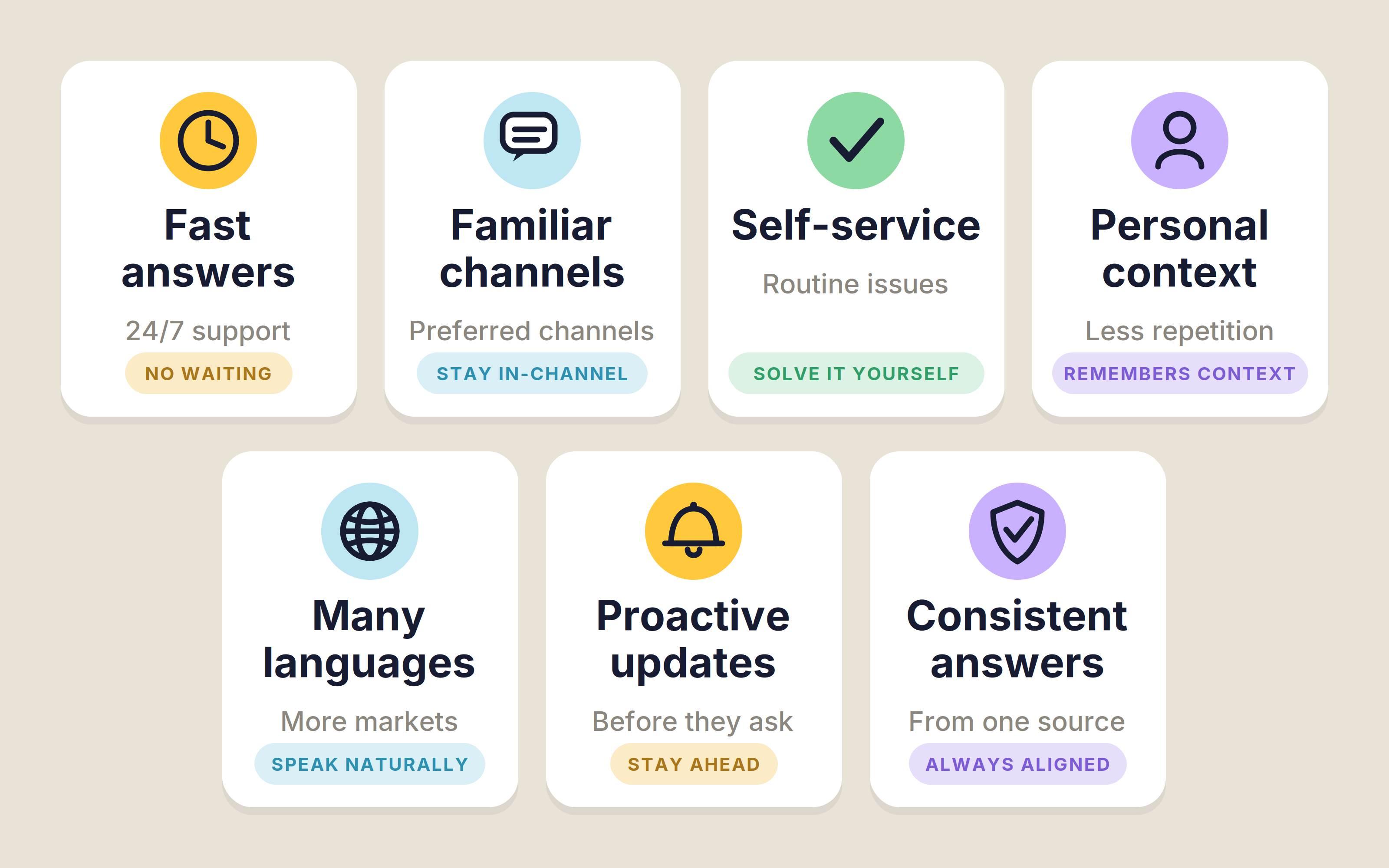
1. Fast, Around-the-Clock Answers
A chatbot replies the moment a customer asks, at 2 p.m. or 2 a.m., with no queue in front of them. Speed is now near the top of what customers want, and recent consumer research puts 46% of people ranking a quick resolution among their highest priorities when they deal with a company. For the common questions, such as where an order is or how to change a booking, an instant answer at any hour resolves the contact before it ever becomes a ticket.
2. Support on the Channels Customers Already Use
Round-the-clock only helps if it reaches customers where they already are. A chatbot can carry the same understanding across web chat, WhatsApp, Viber, Facebook Messenger, SMS, and voice, so a person can start on the channel they use every day and get the same answer whether that is a chat window on the site or a message thread on their phone. Someone who lives in WhatsApp never has to move to email to get a straight answer, and someone who prefers the website gets the same one there.
3. Self-Service That Resolves the Issue
Plenty of customers would rather finish a simple task themselves than wait for an agent to do it for them, and the same research shows where that comfort starts and stops: 63% are comfortable letting AI check the status of an order, while only 30% want it anywhere near advice about a medical problem. The benefit is real for the transactional, low-stakes requests a bot can close on its own, which is exactly the work worth handing to it and leaving the sensitive cases to a person.
4. Personalized Responses From Past Interactions
Connected to order history and account records, a chatbot pulls in the customer's own context and skips the generic script. Ask about a delivery and it already knows which order, the tracking status, and whether there is an open ticket on it, so a customer who messaged support yesterday does not have to explain the situation again today. That saved repetition is often what separates a chatbot interaction that feels helpful from one that feels like starting over.
5. Multilingual Support
One AI chatbot can hold a conversation in dozens of languages without a separate team for each. A customer writes in their own language and gets an answer in it, whether that is French at 9 a.m. or Japanese at 3 a.m., so a smaller or overnight market gets native-language support without hiring a dedicated agent to cover it. For a company selling into a dozen countries, that is the difference between running one support operation and staffing a separate desk for every language.
6. Proactive Outreach Before Customers Ask
Not every contact has to start with the customer. A chatbot can flag a delivery delay the moment a courier update shows it, send a renewal reminder before the plan lapses, or confirm a booking change the second it is made, so the customer hears about it from the company before they open a chat to ask why it has not arrived. The contact still happens; it just happens earlier, while the company can still shape the message and head off the complaint a late notice would have caused.
7. Consistent, Accurate Answers Every Time
A human agent's answers drift with fatigue, call volume, and who happens to pick up. A chatbot gives the same answer to the same question at 9 a.m. and during a midnight rush, drawn from one source of truth. As long as that source is kept current, every customer gets the answer the company actually intends, whatever the hour or the size of the queue.
7 Chatbot Benefits for Support Teams
For the support team, the payoff is quieter than a faster reply but larger once you add it up. A chatbot changes which contacts reach a person at all, how fast the right agent gets the rest, and what each one costs to handle.
1. Fewer Repetitive Requests for Agents
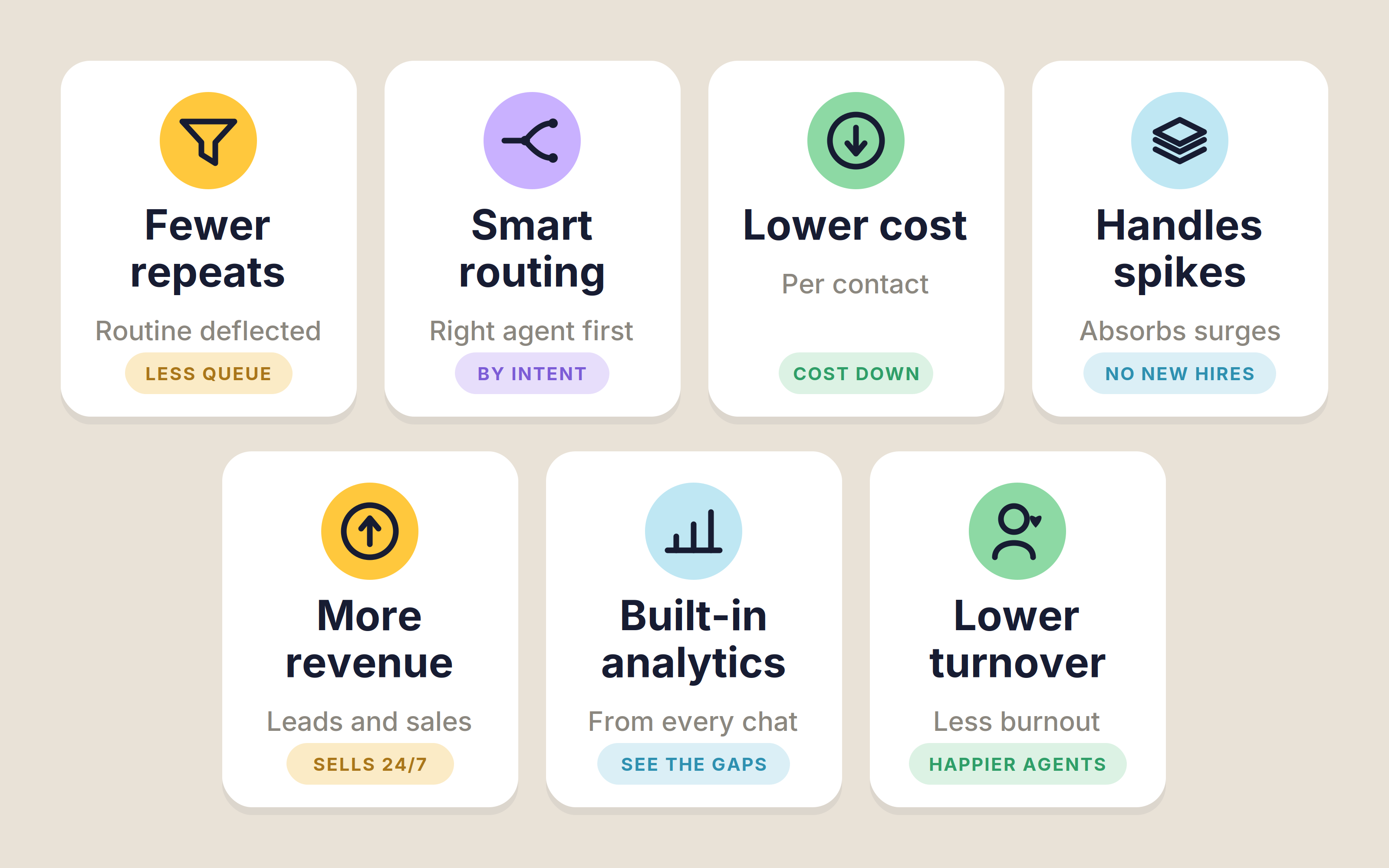
Most of what fills a support queue is the same short list of questions asked over and over, such as password resets, order status, and opening hours. When a bot answers those, they never reach a person, and among the customer-care operations leading on AI, 42% have reversed rising inbound volumes through smarter self-service and digital deflection. That leaves agents on the smaller share of contacts that need judgment a script cannot supply, which is the work worth their training.
2. Smart Routing and Triage by Intent
When a contact does need a person, the bot decides who. It reads the intent behind the message and sends the customer to the queue or agent equipped for it, instead of a general line and a round of transfers. Margon Media saw this directly, with a 28% rise in overall productivity after skill-based routing put each call in front of the agent trained for it and removed the transfers in between.
3. Lower Cost Per Contact
Every contact a bot closes on its own is one an agent does not have to be paid to handle, which pulls down the average cost of each interaction. A single automated resolution replaces the agent minutes that contact would have taken, and across thousands of routine tickets a month, that saved time is where the cost reduction accumulates. The effect runs deepest where volume is high and the questions repeat, since that is where the bot stands in for the most agent time.
4. Scaling Through Volume Spikes
Support load is rarely flat. A product launch, a holiday season, or an outage can multiply contacts overnight, and a human team can only answer as fast as its headcount allows. A chatbot absorbs the surge at the same speed it handles a quiet Tuesday, so wait times hold and the team does not have to hire and train for a peak that lasts two weeks.
5. More Leads and Revenue
A support bot does more than close tickets. Along the way it can qualify a lead, answer the pre-sale question that was blocking a purchase, and guide a customer through checkout without a handoff. Because it works every hour, it catches the buyer who arrives at midnight with one question standing between them and an order.
6. Feedback and Analytics From Every Conversation
Every exchange a bot handles becomes structured data: what customers asked, where they got stuck, and which answers resolved the issue. Read in aggregate, it shows the recurring friction worth fixing and the questions the knowledge base still misses, which feeds back into both the product and the support process.
7. Lower Agent Turnover
The repetitive, low-value contacts are the part of the job agents tend to burn out on. Handing that work to a bot leaves a role built around the harder, more varied cases, which is generally easier to stay in. Teams that track it typically see this as steadier staffing over time, though how much it helps depends on how the role is rebuilt around the bot.
7 Chatbot Benefits by Industry
The same benefits land differently depending on the queue behind them. What a bot takes off a telecom help desk is not what it takes off a hospital appointment line, so it is worth going vertical by vertical to see where the gains concentrate and what has to be handled with care.
1. Telecoms
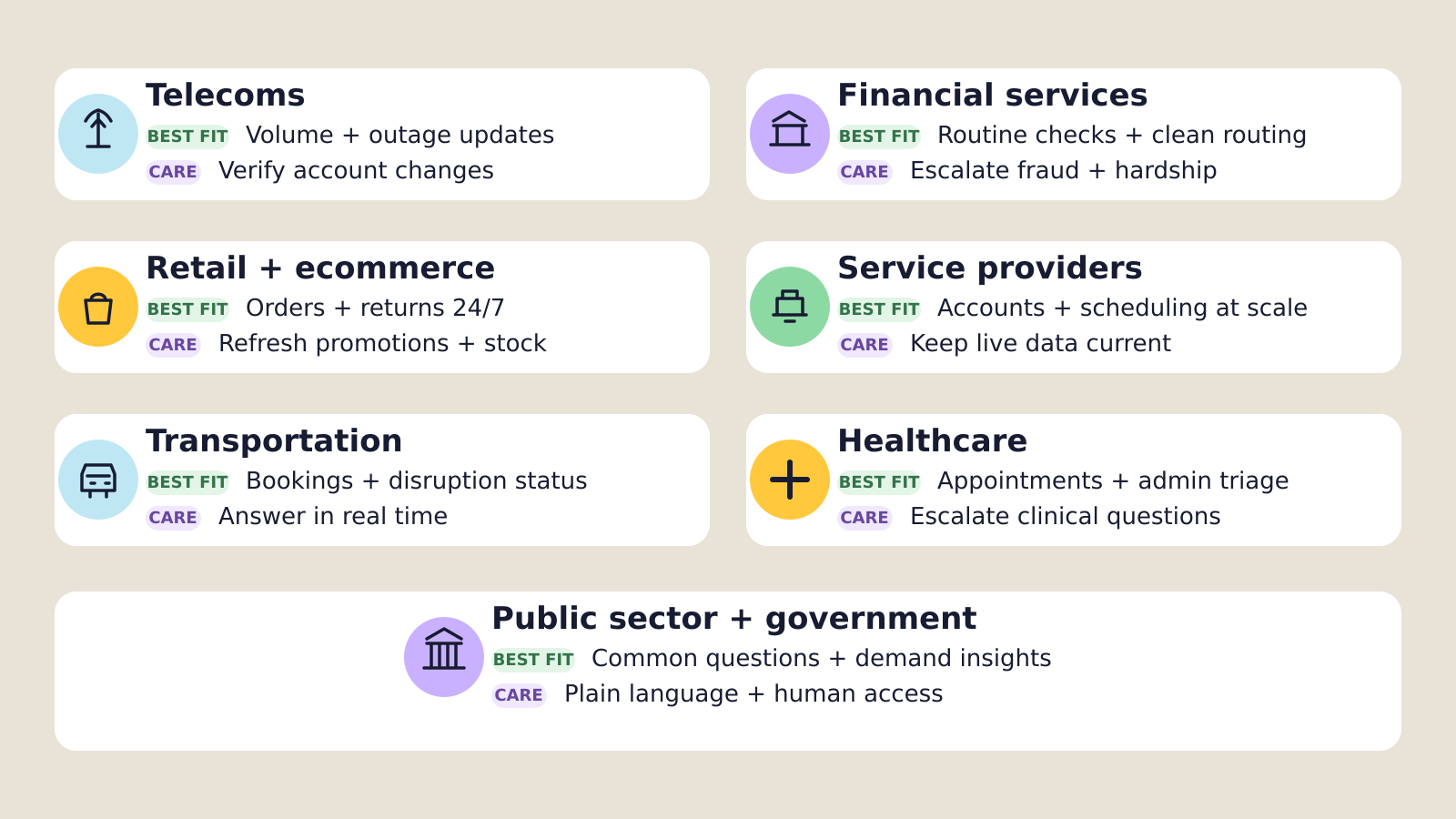
Telecom support runs on volume, with SIM swaps, billing questions, and the outage spikes that build long hold queues.
A bot clears the repetitive contacts and, during an outage, pushes status proactively so thousands of identical calls never stack up in the first place.
Anything that changes an account or a plan needs verification first. Confirm who the bot is talking to before a SIM swap or plan change goes through, and route to an agent wherever the rules require it.
2. Financial Services
Most financial services contacts are quick checks such as balances, payment status, and card actions.
A smaller set, disputes, fraud, hardship, has to reach a person, and a bot earns its value here by telling the two apart: it clears the routine lookups behind authentication and routes anything sensitive straight to a trained agent.
Sending a sensitive case to the wrong place costs more than any deflection saves, so routing accuracy matters here as much as resolution volume.
3. Retail and Ecommerce
Retail support is seasonal and order-shaped, built around questions such as where an order is and how to return it, on a volume curve that spikes with every sale and holiday.
In retail and ecommerce, a bot answers the status and returns questions around the clock and holds service steady when traffic multiplies.
What it has to get right is currency, since return windows, promotions, and stock all change fast, and the bot's answers are only as good as how often that information is refreshed.
4. Service Providers
Service providers such as utilities and subscription businesses carry a steady load of scheduling, account changes, and outbound contact at scale.
In service providers, a bot handles the routine account work and can reach out first for renewals, appointments, and service updates without adding headcount for every cycle.
That payoff rests on live data, since a scheduling or account answer that is out of date creates a second contact instead of preventing one.
5. Transportation
Transportation support turns on real-time status, such as bookings, cancellations, and delays, plus the wave of questions every disruption sets off.
A bot can confirm a booking, push a change, and answer "where is my train" the instant it is asked.
In transportation, that immediacy is the main gain, since the bot gives the same fast status answer to one traveler or to ten thousand at once mid-disruption.
6. Healthcare
Healthcare carries the sharpest line of any industry here: administrative work like appointment booking, reminders, and basic triage is safe for a bot, and anything clinical is not.
A bot answering a clinical question it should have escalated costs far more than a slow reply would have.
Handle the scheduling and routine requests, free staff for care, and escalate anything medical to a qualified person without delay. That escalation path is what the benefit ultimately depends on.
7. Public Sector and Government Services
Public services field high volumes of citizen inquiries, from service requests to status checks, often on thin staffing and against rising expectations.
In the public sector, a bot answers the common questions and, paired with detailed analytics, shows agencies where demand concentrates and which processes to fix.
Because the audience is everyone, it has to stay in plain language and keep a clear route to a person for the cases where self-service is not enough.
Where Chatbots Fall Short and How to Handle It
A chatbot earns its benefits only where it is set up to fail gracefully. Three limits come up often, and each has a concrete fix.
Complex and Emotional Queries
A bot handles the routine and transactional well and struggles the moment a contact turns complicated or emotional, such as a billing dispute, a cancellation, or a customer who is already upset. Push one of those through a script built for order-status questions, and the customer feels ignored at the exact moment they needed to feel heard, which is when a complaint turns into a public one.
Set explicit handoff triggers for those cases, such as repeated failed attempts, specific keywords, or a direct request for a person, and pass the full conversation across so the customer does not start over with the agent. Decide upfront which categories skip the bot entirely, since some contacts should reach a human on the first message.
Bot Loops and Dead Ends
The quickest way to lose a customer to a bot is to trap them in one, cycling through the same menu with no way out.
Keep a visible route to a human at every step, such as a standing option to reach an agent, and cap how many times the bot retries before it escalates on its own. Watch the transcripts for the points where conversations stall, since a recurring dead end is usually a missing answer the bot can be taught.
Keeping Answers Accurate
A bot is only as right as the knowledge base behind it, and an answer that was correct at launch goes stale the moment a price, policy, or product changes. A customer who acts on that stale answer, books a rate that no longer applies or expects a return window that has already closed, is now owed an explanation, and sometimes a refund, for something the company's own bot told them.
Assign clear ownership for keeping that source current and update it as part of every release. Review a sample of real conversations on a set schedule to catch answers that have drifted, so a wrong reply is corrected before it reaches many customers.
How to Get the Most From a Support Chatbot
The benefits are not automatic. They follow a few setup choices that decide whether the bot resolves contacts or just moves them around.
Connect the Bot to Your Knowledge Base
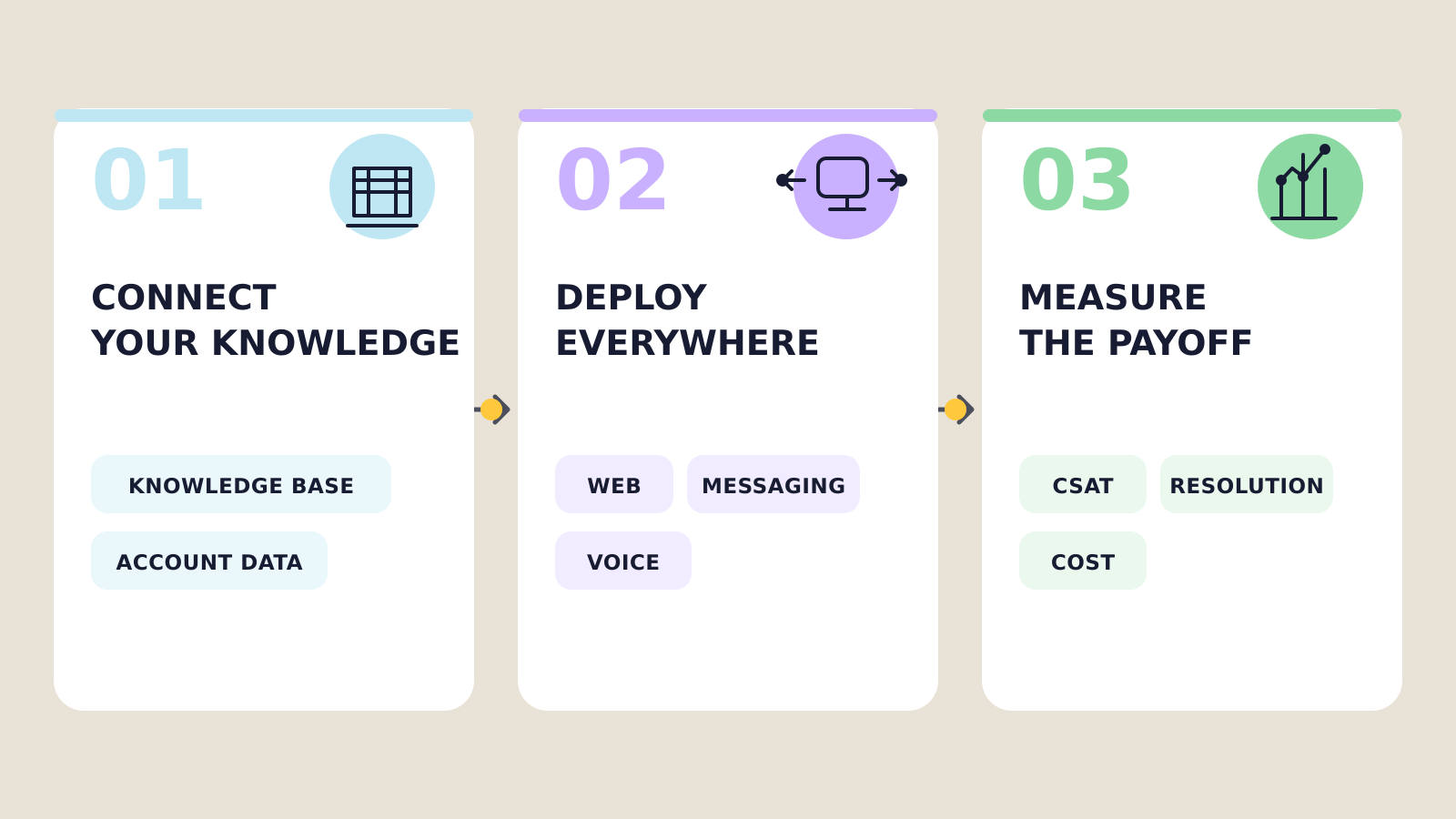
A chatbot can only answer from what it can reach. Connect it to your knowledge base, help center, and the account systems that hold order and customer data, so it replies from current, specific information instead of generic guesses.
The wider and cleaner that connection, the more the bot resolves on its own, which makes the knowledge base the main input worth maintaining rather than a one-time import.
Deploy Across Every Customer Channel
Customers do not pick one channel and stay there. Put the same bot, with the same knowledge behind it, across the channels they already use, such as web chat, WhatsApp, Viber, Facebook Messenger, SMS, and voice, so the answer holds wherever the question comes in.
Building once and deploying everywhere also means a correction to one answer reaches every channel at once instead of being patched place by place.
Measure CSAT, Resolution Rate, and Cost Per Contact
Three numbers tell you whether the bot is working. Resolution rate shows how many contacts it closes without a human, cost per contact shows what each interaction costs once the bot takes the routine share, and CSAT shows whether customers are satisfied with the answers they get.
Track the three together, since a high resolution rate with slipping customer satisfaction usually means the bot is closing conversations it should have escalated.
The Benefits Platforms Like Nexios Bring
Everything above is easier on a platform built for it.
Nexios runs support as an omnichannel contact center where its chatbots and virtual agents read intent, answer in the customer's language, and hand off to a person the moment a case needs one, with reporting and analytics turning every conversation into data you can measure against.
Because web chat, WhatsApp, Viber, and the rest run on one system, the bot and your agents work from the same context and knowledge on every channel.
For pricing built around your volume and setup, talk to the team.
Chatbot Benefits FAQs
1. What are the main benefits of chatbots?
The main benefits of chatbots are faster answers for customers and less repetitive work for support teams, delivered around the clock and across every channel. Because they resolve routine contacts on their own, they lower the cost of each interaction and free agents for the complex cases that need a person.
2. How do chatbots benefit customers specifically?
Chatbots benefit customers by answering common questions instantly at any hour, in the customer's own language and on the channel they already use, with no queue in between. For simple, transactional requests such as order status or a booking change, the customer finishes the task in the moment instead of waiting for an agent.
3. Do chatbots reduce customer service costs?
Chatbots do reduce customer service costs by handling routine contacts automatically, which lowers the average cost of each interaction. The savings are largest where volume is high and questions repeat, and one widely cited projection puts the eventual reduction in operational costs at around 30%.
4. Are AI chatbots better than rule-based chatbots?
AI chatbots are more capable than rule-based ones for most support work, because they read intent, hold context across a conversation, and improve with use instead of following a fixed script. Rule-based bots still do well on narrow, predictable tasks where the questions rarely change.
5. What are the disadvantages of chatbots?
The disadvantages of chatbots show up with complex or emotional queries, dead-end loops that leave customers with no way to reach a person, and answers that go stale as products and policies change. Each of these is manageable with clear handoff rules, a visible route to a human at every step, and a knowledge base that is kept current.
Get free insights via email
Practical support insights on service metrics, AI and the playbooks teams actually run, straight to your inbox. Free, unsubscribe anytime.